
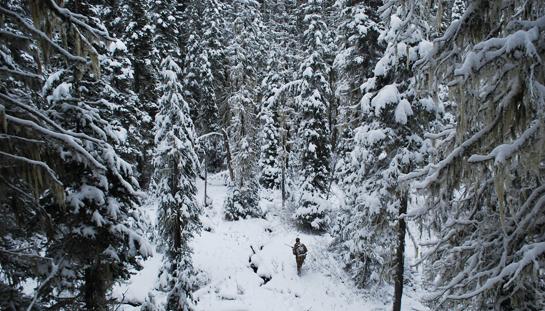
HUNTING STRATEGIES
1) GO EXTRA SLOW
When still-hunting, most of us don’t move slowly enough, or stay put long enough. Try using your watch as a guide. Decide on a period of time to stand still, such as five minutes. This way you’ll be forced to remain quiet and silent for a minimum amount of time, longer if necessary.
2) STOP AT THE NOISE
Here’s a saying I came up with to remind me of an animal’s terrific senses. “The sound of a snapped twig is quickly forgotten by the hunter, but long remembered by the quarry.” If you make an unusually loud noise, stop and stand there as long as you can if you suspect animals are close by. A deer might stand a long time and stare in your direction. If it doesn’t see or smell you, it might go back to feeding or whatever else it was doing before it was disturbed.
3) QUICK-STEPPING FOR DEER
A deer is easily alerted to human cadence as we walk through noisy leaves. This might sound like a dumb idea, but try taking quick steps in a short sprint for 10 to 20 yards or so. Stop, and do it again. Keep your footfalls as light as possible; you’ll be surprised at how much you sound like a squirrel scrambling through the leaves.
4) DESIGN A BETTER DRIVE
When putting a drive together, we tend to place standers in front of and alongside the area being driven. If you have enough people in your party, position a stander in the rear where the drive originated. Deer will often wait for hunters to pass and then sneak back and run off in the opposite direction.
5) DRIVE SOLO
Try a one-man drive if you’re hunting alone. Purposely walk into an area with the wind at your back. The idea is to stir deer up and get them moving. Once you’ve passed through, make a circle and do it again. You might see confused deer creeping about, unsure of your location. If this doesn’t work, take a position on the flank of the area you walked through and wait an hour or two. You might see deer sneaking back in, believing the danger has passed. This works in dense thickets that deer use for security cover.
6) PICK YOUR LANDMARKS
When you plan to stalk an animal by making a big circle and coming up behind it, it’s easy to become confused as you change your location. Pick a distinctive object on the skyline that you can recognize from the back, such as a large tree, a fence line or a rock, to help guide you to the correct spot.
7) JUDGE THE QUARRY’S PACE
Also try to anticipate where the animal will be once you complete your stalk. Before starting, watch the quarry long enough to determine its direction and rate of travel if it’s actively feeding or walking. Pick your destination accordingly.
8) FOLLOW WITH CARE
If you’re tracking an animal, remember that the quarry will be alert to its back trail. A really fresh track requires you practically to still-hunt rather than merely follow, especially if the animal isn’t “lined out” but is taking bites of browse as it goes.
9) CLEAR SHOOTING LANES
When you first get into your tree stand, practice taking up shooting positions for all the directions from which an animal might appear. After doing that, try to remove branches in the line of fire if you can reach them, and take up the position that requires the least amount of movement for you to turn in any direction. Be sure your safety strap is secure and allows free movement.
The Midnight Troubadour

Tough and timeless, this polo is built for the long ride. Featuring a crisp, non-collapsing collar and a rugged, stretchy fabric, it's the perfect shirt for any cowboy's wardrobe.
10) SWEEP AWAY BLIND CLUTTER
If you’re sitting in a ground blind or standing next to a tree, sweep away leaves and brush with your boot so the area you’re in is clean of forest debris. This will eliminate unnecessary noise if you must make a move when an animal approaches.
11) GLASS AND RE-GLASS
When glassing with a binocular early in the morning, move to your vantage point in the dark. Glass likely spots, but don’t take just a single cursory look. From time to time, refocus your attention on places you’ve already checked out. The changing light might reveal animals you hadn’t seen before or animals that have moved out of deep brush or timber.
TRACKING
12 HOW TO FOLLOW A BLOOD TRAIL Move quietly as you track. Be alert for the quarry, which might be bedded just ahead. If other hunters are with you, communicate with hand signals. Mark every spot of blood with a piece of toilet tissue or flagging, which should be removed later.
13 DON’T GIVE UP Many times a good blood trail that you’ve followed a long way will peter out to nothing. That’s not a good sign, because the animal is still going strong, but it doesn’t mean it isn’t fatally wounded. Don’t give up. Start looking for tiny spots of blood. Get on your hands and knees, if necessary, to help keep you on the spoor.
14 CALL THE SPOT If you’re hunting in a brushy area and you drop an animal at a distance, make a mental note of where it stood at the shot, especially if you must take your eyes off it to get there. It’s vitally important to find the precise area so you can pick up the blood trail.
15 BEWARE OF THE ‘INSTANT DROP’ An animal that drops at the shot is more likely to run off than one that doesn’t go down but runs some distance and then falls. The animal that falls immediately might do so from shock, then recover and run. When an animal drops instantly, stay put and be prepared for a quick follow-up shot.
16 NO EYE POKES Television hunting-show hosts like to walk up to a fallen animal and prod it with the firearm muzzle to make sure it’s dead. That’s dumb. The last thing you want is for an animal to leap up when you’re so close that you can’t take action. Instead, toss a stone or branch at it and look for a reaction. If an animal’s eyes are closed, it’s probably still alive. If there is any sign of life, shoot it in the throat under the chin to administer a humane coup de grâce and not waste meat.
17 LOOK UP FOR BLOOD When tracking a wounded animal, don’t stay focused only on the ground. Look for blood higher up on the sides of trees, on grass heads, and on stems of brush. Sometimes we’re so intent at looking for traces on the fore
Source: https://www.outdoorlife.com/articles/hunting/2015/03/50-great-hunting-tips/
