
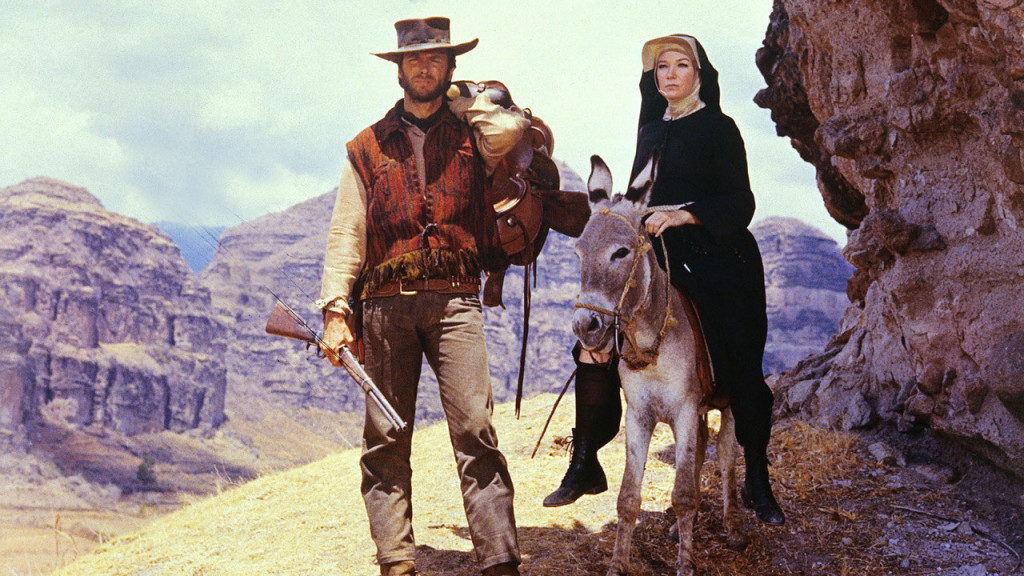
One month after offering a passel of John Wayne westerns as a Thanksgiving feast, the AMC cable network has added Clint Eastwood to the mix for another holiday marathon. The cavalcade begins Christmas Eve with Eastwood’s The Outlaw Josey Wales, and concludes during the wee small hours of Monday morning with Wayne alongside Robert Mitchum and James Caan in El Dorado. Here’s what the lineup looks like:
The Outlaw Josey Wales (1976)
Clint Eastwood had already directed four features — Play Misty for Me (1971), High Plains Drifter (1973), Breezy (1973) and The Eiger Sanction (1975) — before making his true breakthrough as a filmmaker with this much-admired drama about a former Confederate guerrilla who refuses to lay down his guns after the Civil War, and reluctantly assumes responsibility for a makeshift community of outcasts while trying to avoid dogged pursuers. Although it received mixed reviews during its initial theatrical release, the movie gradually gained acceptance as a classic — and established Eastwood as a world-class filmmaker. Six years after its premiere, Orson Welles of Citizen Kane fame proclaimed: “I suppose Clint Eastwood is the most underrated director in the world today... [A]n actor like Eastwood is such a pure type of mythic hero-star in the Wayne tradition that no one is going to take him seriously as a director. But someone ought to say it. And when I saw [The Outlaw Josey Wales] for the fourth time, I realized that it belongs with the great westerns. You know, the great westerns of Ford and Hawks and people like that. And I take my hat off to him.” (8 pm Saturday, 3 pm Sunday)
The Cowboys (1972)
Desperate times call for desperate measures. When cash-strapped cattle rancher Wil Andersen (John Wayne) can’t afford grown-up cowhands, he hires some teenage greenhorns to drive his herd to market. And when Andersen is killed by a psycho varmint (Bruce Dern), the boys must become gunmen to avenge his death. Director Mark Rydell, no fan of The Duke’s politics, admits that he originally didn’t want Wayne for this cult-fave Western. “So I surrounded him with a lot of hippie, pot-smoking crew members,” Rydell recalls. “I didn’t want him to be comfortable. But you know what? He was a gentleman, he was friendly. He was great with the kids, who were always around him. They would climb on him like a monkey bar on a playground. He always had time for everybody. And he taught me a lesson, an important lesson, in my life: not to judge too quickly.” (11 pm Saturday, 12 noon Sunday)
The Midnight Troubadour
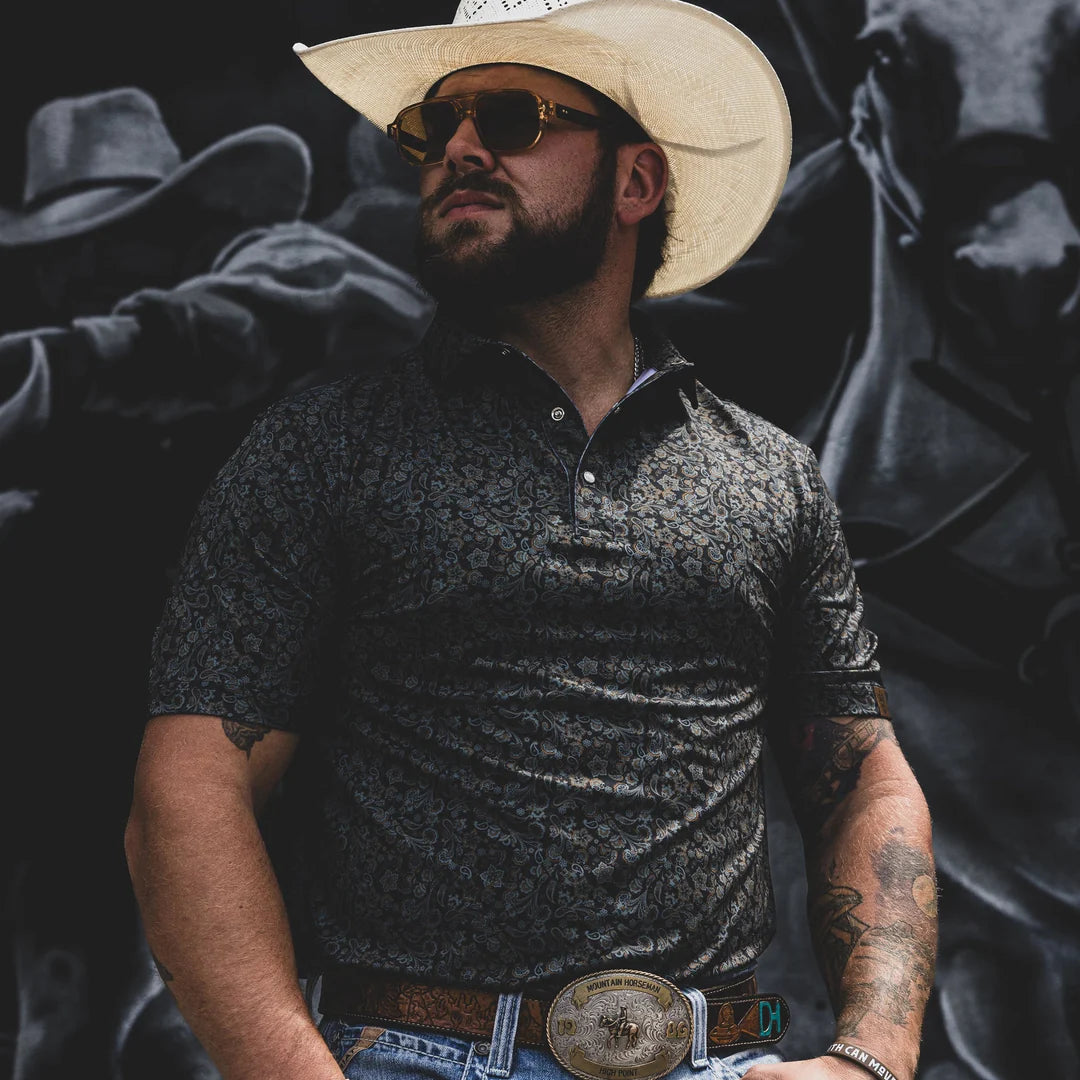
Tough and timeless, this polo is built for the long ride. Featuring a crisp, non-collapsing collar and a rugged, stretchy fabric, it's the perfect shirt for any cowboy's wardrobe.
The Sons of Katie Elder (1965)
As we noted in our 50th anniversary commemoration, this fan favorite was the first film Wayne made after his life-saving 1964 cancer operation: “Wayne remained every inch the thoroughgoing professional throughout the arduous production of The Sons of Katie Elder, determined to prove that he had indeed ‘licked the Big C’ and was back in the saddle, literally as well as figuratively. If he ever resented [director Henry] Hathaway’s demanding drill-sergeant style of directing, he chose not to hold a grudge — and, just four years later, gladly re-teamed with the director for True Grit (1969), the movie for which he won his only Academy Award for Best Actor. Some biographers have theorized that The Sons of Katie Elder was an invaluable boon to John Wayne, in that it convinced him that working hard at what he did best was the way to continue cheating death. Such armchair psychology is usually of dubious value while taking the measure of any man. But in Wayne’s case — well, maybe there is something to the notion that there’s nothing like a brush with death to reignite one’s work ethic.” (2 am Sunday)
Joe Kidd (1972)
Working from an original screenplay by novelist Elmore Leonard, veteran director John Sturges (The Magnificent Seven, Gunfight at the O.K. Corral) guides Clint Eastwood through his paces as the title character, a former bounty hunter who signs on with Frank Harlan (Robert Duvall), a greedy land baron, to join the manhunt for Mexican outlaw Luis Charma (John Saxon). As the hunt progresses, however, Kidd shifts his sympathies to the outlaw — and realizes Harlan is responsible for even worse criminal activities. This may be the only western ever made in which the climactic shootout is triggered when the protagonist drives a train off the tracks — and into a saloon filled with bad guys. Hey, whatever works. (5 am Sunday)
Two Mules for Sister Sara (1970)
Clint Eastwood and director Don Siegel collaborated on five movies, including a bona fide classic (Dirty Harry) and an offbeat cult favorite (The Beguiled). Two Mules for Sister Sara isn’t quite on the same level as those two films, but it is undeniably entertaining, largely because of the chemistry sparked between Eastwood as his sassy and sexy co-star, Shirley MacLaine. He is a gunfighter who agrees to help Mexican revolutionaries in their campaign against the French, and she is a nun — at least, that’s her story — who claims to have, ahem, intimate knowledge of the men assigned to a strategic French fort. (7 am, Sunday)
The Shootist (1976)
On Jan. 22, 1901, legendary gunfighter J.B. Books (John Wayne) rides into Carson City, where a local doctor (James Stewart) confirms his worst fears: “You have a cancer. Advanced.” At the time of its release, The Shootist discomforted many fans who couldn’t help viewing it as an unwelcome reminder of The Duke's real-life battles with “The Big C.” But now, decades after Wayne’s passing, this under-rated western can be better appreciated as a respectful elegy for a Hollywood professional of tremendous dignity and stature. (A nice touch: The opening credits are flashed over clips from many of Wayne’s earlier westerns.) One might argue the film isn’t quite equal to the man it honors — but there’s no denying that The Shootist allows Wayne one of his very few opportunities to play a character who frankly expresses a fear of his own mortality (“I'm a dying man, a-scared of the dark!”) even while remaining true to his personal code: “I won't be wronged. I won't be insulted. I won't be laid a hand on. I don't do these things to other people, and I require the same from them.” Directed by Don Siegel, The Shootist is deeply moving as it symbolically ends an era of history, and literally ends a historic screen career. (9:30 am Sunday)
El Dorado (1967)
If the plot of El Dorado seems a tad familiar, well it should — director Howard Hawks more or less recycled it from Rio Bravo (1959), and then re-recycled it for Rio Lobo (1970). But never mind: As often is the case with John Wayne westerns, the storytellers, not the story, are what really matter here. As critic Roger Ebert noted in his original review: “Wayne plays a professional gunman who comes to town to take a job from a rich rancher who wants a poor rancher’s water (who says the plot has to be original?). But the sheriff turns out to be his old buddy, [Robert] Mitchum, and so he turns down the job. Then the rich rancher hires another gunman (Christopher George), and Wayne sides up with the drunk and disheveled Mitchum. Duke’s team isn't exactly made of heroes. Mitchum has been hitting the bottle for two months, his deputy (played with charm by [Arthur] Hunnicutt) is a windy old Indian fighter, Wayne has a bullet near his spine that causes a slight touch of paralysis now and again, and his sid
