
You’ve got to know the rules.
That’s true with most things in life, but especially if you’re interested in observing grizzly bears in the wild.
check out our premium collection
And why shouldn’t you be? Grizzlies are the ultimate charismatic megafauna, true symbols of the remaining American wilderness. A sighting can be a near-religious experience and is guaranteed to raise your heart rate. The mere possibility of an encounter focuses the mind, demanding close attention to your surroundings.
Grizzlies aren’t everyone’s cup of tea. After all, the brown bear, the species that includes the grizzly, can grow to huge proportions, and they are generally more aggressive and dangerous than their smaller cousins, black bears. Alaskan brown bears, such as the Kodiak, can weigh as much as 1,600 pounds, and inland grizzlies can top 800. Brown bears in the lower 48 are typically smaller, but there’s a record of a 2,200-pound grizzly killed in California back in 1866.
Prior to the influx of Western settlers and prospectors, North America’s apex predator roamed freely from the Mississippi to the Pacific, widely feared and respected by its few human neighbors. The Corps of Discovery at first doubted Indian tales of grizzly ferocity, but after many harrowing encounters, Meriwether Lewis noted in an understated May 1805 journal entry: “I find that the curiossity of our party is pretty well satisfied with rispect to this anamal ... .”
The Midnight Troubadour

Tough and timeless, this polo is built for the long ride. Featuring a crisp, non-collapsing collar and a rugged, stretchy fabric, it's the perfect shirt for any cowboy's wardrobe.
Today, the grizzly’s habitat has been diminished to a corridor tracing the Rocky Mountains northward from Wyoming to Alaska. California, which claims the grizzly as the state animal and pictures one on its flag, saw its last silvertip bear in 1926. Arizona’s last sighting was in 1939; Colorado’s in 1979.
Within its realm, the grizzly has been doing relatively well in recent decades. Being a protected species has helped, but even now there are threats. Warmer winters, which have encouraged the spread of pine bark beetles, have meant fewer white bark pines — an important source of grizzly food. The introduction of lake trout into the Yellowstone ecosystem is another threat: Cutthroat trout, a shallow water food source for grizzlies, are being supplanted by the deep water lake trout. Though grizzlies are omnivorous and adaptable, it’s yet to be seen how the loss of these food sources will affect their behavior.
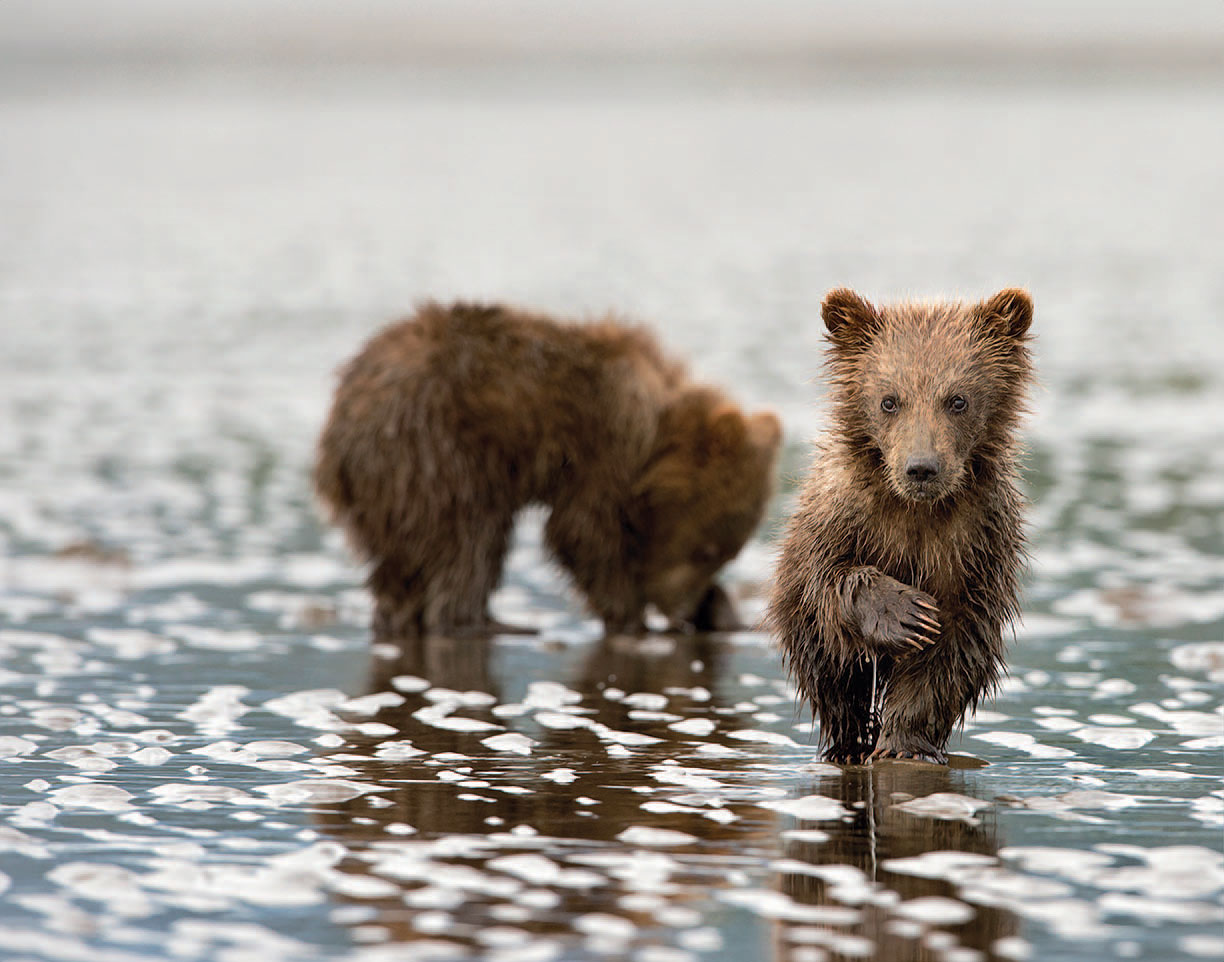
My closest encounter with a brown bear was in Alaska’s Katmai National Park & Preserve. I had kayaked with a group of friends up a narrow river to fish for salmon under a waterfall and hadn’t been there long before we saw, about 25 yards away, a 400-pound sow with two cubs heading down the path right toward us. The beach was only about 6 feet wide, and any potential retreat was cut off by the cliff at our backs and the waterfall in front. We raised our arms to increase our profile, but on she came, followed by her chubby cubs.
Ten yards away and there was no sign that we even registered on her radar. I was getting nervous. We were trapped, with only a can of bear spray for protection. She might pass without incident, but the thought of getting between the bear and the cubs was alarming.
Mom was now just 15 feet away. She started wading through the last pool between us.
I picked up a stone and tossed it gently at the rock wall next to her, saying forcefully but matter-of-factly, “Go back.”
She gave a startled look, huffed, and — just like that — turned around and walked away.
Not too far, though. She headed back just across the stream. One cub followed, but the other balked, forcing Mom to fetch it. The cubs played as the sow caught a flounder and then all strolled back toward the bay.
When our group returned to the kayak, we found that mother and her pair of cubs had roughed it up a bit. They had also snacked on most of a life preserver — perhaps as payback for hogging a favorite fishing hole?
Katmai bears are, fortunately, more tolerant than their cousins in the lower 48. We would ultimately see dozens in the area, some approaching 1,000 pounds, and quickly became almost nonchalant — some might say foolhardy — about their presence, at times letting them get within 10 or 15 feet before moving away.
Charismatic as grizzlies are, it is important to resist the urge to see them as cuddly, anthropomorphized critters. Smart, resourceful, individualistic, and beautiful, they are also potentially dangerous. Seeing one from a safe distance is an amazing privilege — getting mauled by one can be fatal.
If you want to see grizzlies in the lower 48, you’re pretty much limited to three national parks: Yellowstone, Grand Teton, and Glacier. You might stumble upon one in other parts of Montana, Wyoming, Idaho, or Washington, as they are protected everywhere, but your chances are much better in the parks. Don’t expect to see one every day, or even every visit. You’re actually more likely to see black bears — but any bear sighting is a gift.
Yellowstone
The Greater Yellowstone Area, which encompasses both Yellowstone and Grand Teton national parks and surrounding areas in Wyoming, Montana, and Idaho, is the epicenter for grizzly activity. In 2011 it was estimated the area was home to 600 bears.
Personally, I’ve had relatively little luck in Yellowstone itself. My only confirmed sightings have been near the road at the east entrance and in Hayden Valley (the Hayden grizzly was heading away from the park road, pursued by a crowd of foolish gawkers). While that incident passed without injury, not all park visitors have been so lucky. In 2013, four individuals had their own encounters during two separate grizzly attacks. Keep that in mind when visiting Lamar Valley, reputedly a good place to see grizzlies, as well as wolves.
Grand Teton
Some years ago, on Grand Teton’s Cascade Canyon trail, I had my first-ever bear-induced adrenaline spike, and I was hooked. We rounded a turn and saw, perhaps 50 yards ahead, a brown-colored bear in a clearing, apparently feeding. The bear lurched to its feet and circled nervously, obviously aware of us and not happy about it. Retreating, we let it finish lunch and only then saw a freshly killed mule deer fawn just off the trail.
It was probably a grizzly, but I couldn’t say for sure. Not that it really matters. Coming between any bear and its food breaks the rules.
As recently as 10 or 15 years ago your chances of a grizzly sighting in Grand Teton would have been slim. Now, however, with an expanding Greater Yellowstone Ecosystem population, grizzlies have pushed southward, providing you with a good chance of seeing one from the road in this compact and easily accessible national park.
I’ve never actually seen one from the main park highway, but I have had several great sightings from U.S. Highway 89, which runs along the east side of the park. Last summer I witnessed Bear 610 and her three 2-year-old cubs gingerly dancing their way through a bison herd not far south of Moran Junction, Wyoming. It was hard to tell which group was more nervous.
Two years earlier I was able to watch a boar (male) grizzly feeding on an elk carcass about 50 yards off the highway not far from the Cunningham Cabin. He chowed down for several days while rangers kept viewers away. In the spring of that same year, in a large meadow just east of Oxbow Bend, I got to watch two grizzlies courting a quarter of a mile from the road. I think the boar struck out.
These were all safe encounters, but closer sightings can be dangerous and call for adherence to the usual rules (see below). Grand Teton National Park authorities have identified six bear maulings since 1994, when a jogger was injured on the Emma Matilda Lake Trail. Most recently, in November 2012, a grizzly protecting a kill attacked a group of elk hunters and was shot. None of these cases resulted in human fatalities.
Glacier
It’s a slightly different story up north in Glacier National Park. Hardly a summer season passes without bear-human interactions, and since the first bear fatalities in the park in 1967,
Source: https://www.cowboysindians.com/2016/08/bear-in-mind/
