
Billionaire Bob Parsons is Shaking Up the Golf Industry

It’s 9 a.m. at Scottsdale National, and as the sun rises over the Southwestern rockscape, the club owner is sitting at his desk. In the middle of the 15th green.
Bob Parsons—Harley rider, entrepreneur, disrupter of the natural golf world—is dressed in all black, including a recent 65th-birthday treat: a stud earring stamped with the initials “PXG.” Parsons looks like a pirate, and, indeed, the cavernous bunker behind him—”The Mineshaft”—features a sign with skull and crossbones. When his wife, Renee, got up and down from it the first time they played it, he ordered it to be made a foot deeper. Parsons business maxim No. 1: Be willing to adapt.
“I’ve done this before,” Parsons says in his choked growl, making friends with the photographer. By “this” he means pose for a portrait. “It’s not my first rodeo, cowboy.”
The Midnight Troubadour
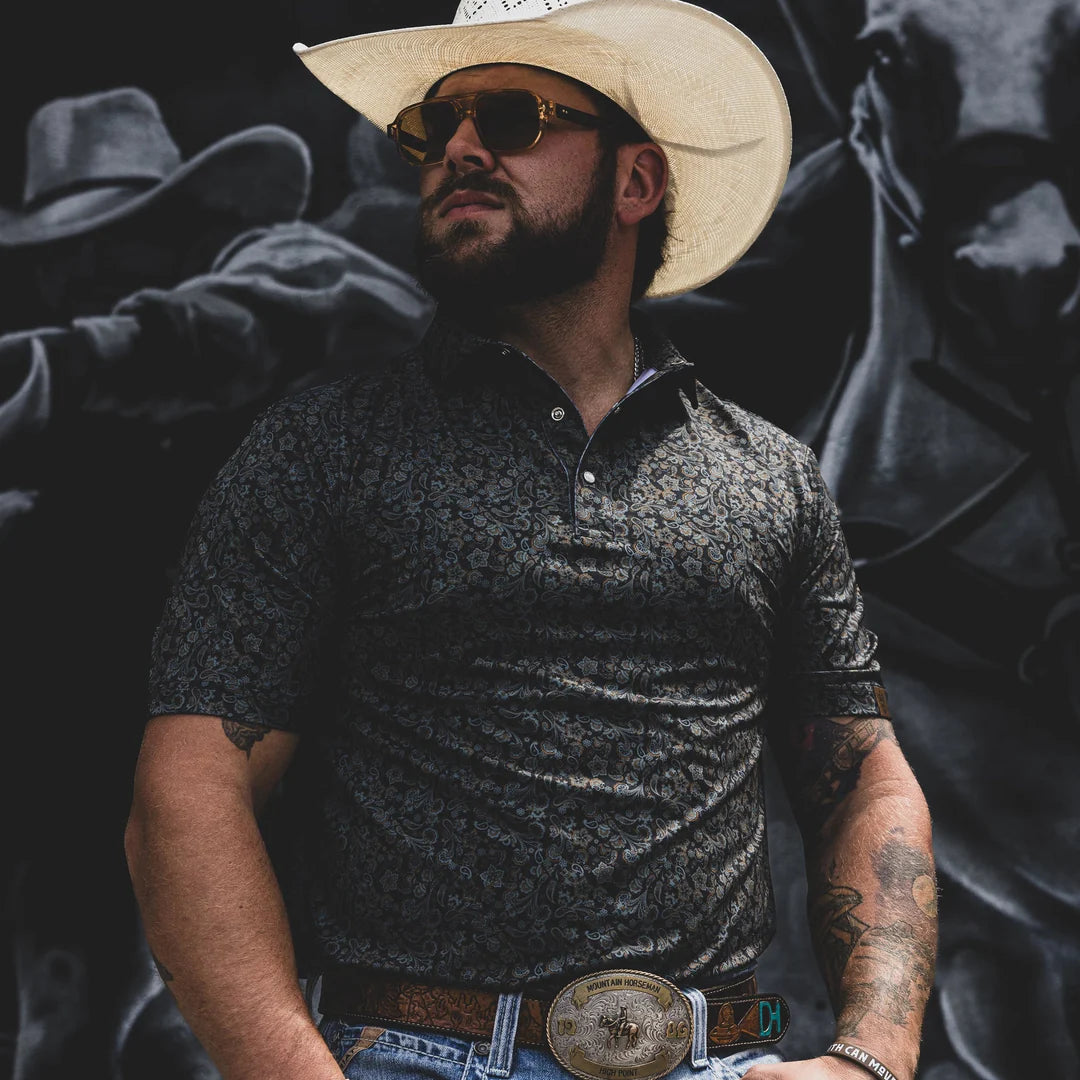
Tough and timeless, this polo is built for the long ride. Featuring a crisp, non-collapsing collar and a rugged, stretchy fabric, it's the perfect shirt for any cowboy's wardrobe.
That may be so, but he’s new to the golf establishment, which Parsons rocked in January when he announced that PXG (Parsons Xtreme Golf), his upstart club company, had signed Zach Johnson, Billy Horschel, Chris Kirk and Cristie Kerr, among others, to play its equipment. The news came less than a year after PXG began selling its innovatively designed sticks.
On the 15th green, Parsons, as usual, has drawn a crowd. Soon the entourage will head to 16, where Parsons will be photographed on his motorcycle, a muscular black hog plastered with macho logos: “Marine Corps,” “0311” and, of course, “PXG.” Parsons business maxim No. 2: Be memorable.
Here’s the deal: We have people comin’ to us all the time,” Parsons says, kicking back after the photo shoot in one of Scottsdale National’s small conference rooms. As proof, on the nearby range, Rocco Mediate is testing PXG clubs. “We’re booked. We’ve [already] got six guys on the men’s tour, and the guys we got are all winners.”
He goes on. “The rumor going around is that we’re spending outrageous sums [to sign] these guys. All of “em came to us. We didn’t reach out to any of “em. And all of “em are making less than what their prior spouse wanted to pay “em.”
“Prior spouse.” Parsons snickers at his own choice of words. You can see why a reputation for outrageousness precedes him. In short order, he has launched a boutique equipment company in one of the toughest business climates for golf in decades, developed a golf club that pros like Johnson say they love to hit, and thrown a charge into the staid world of irons and woods. Disruptive? Well, yes—shouting from the rooftops about how you’ve built a better mousetrap always is.
But Parsons has always gone big. The tech-world entrepreneur and self-made billionaire, who founded GoDaddy in 1997, gleefully sexed up the otherwise boring Internet-domain-name business with a series of audacious Super Bowl ads. His real office desk is made from the door of a C-119 military transport aircraft. He owns a 150,000-square-foot Harley-Davidson dealership in Scottsdale with its own tattoo parlor (Parsons has inked both his arms) and wedding chapel (he officiated the first wedding). He owns 18 motorcycles himself. “Because,” he says, “17 didn’t seem like enough!”
Brash and bumptious, Parsons can come off as Trump with body art. But he’s not that at all. Trump’s father staked him to seven figures in New York. Parsons’ dad sold furniture at Montgomery Ward, and Parsons grew up, he says, as “poor as a church mouse,” in Baltimore. Parsons gives millions to progressive causes, like a shelter in Phoenix for at-risk LGBT youth. He supports Hope For Haiti and has traveled to that struggling country three times.
“He always had the fanciest gear, and he was a golf nut, but he’s also a sweet man who is big into philanthropy,” says PXG convert Zach Johnson, who was about 10 when he first met Parsons, in Cedar Rapids, Iowa, where start-up Parsons Technology was based. At the time, Johnson was working in the bag room at Elmcrest Country Club.
Parsons has taken the Giving Pledge, promising to commit at least half his fortune—estimated at $2 billion—to charity. Yet he’s no saint.

Like other titans of industry, he shoots from the hip—and asks questions later. He made a few enemies upon taking over Scottsdale National. And he got hate mail in 2011 when a photo of him standing over a dead elephant in Zimbabwe hit the Internet. Parsons says he kills “only if there’s a reason to,” and that he was protecting the fields of Zimbabwe’s subsistence farmers. He hasn’t hunted in Africa since—he hasn’t had the time. “I let no grass grow under my feet, brother,” he says. That’s Parsons business maxim No. 3: Hustle—always.
Of PXG’s stable of players, Parsons says Horschel is most like him. They’re both “worker bees,” though Parsons lacked that work ethic as a kid in Catholic school in the early “60s. A self-described “pain in the sisters’ ass,” he nearly flunked fifth grade. He didn’t fare much better in high school.
Then came Vietnam. In 1968, as a 17-year-old, Parsons joined the Marine Corps. Several months into his tour, he stepped on a tripwire and was badly wounded. He still has shrapnel in his arms and legs. He received an honorable discharge and the Purple Heart.
Parsons lived his second-chance life nothing like his first. He enrolled at the University of Baltimore, graduated magna cum laude, and taught himself to code. Success came slowly. He lost every penny of the $15,000 he put into Parsons Technology in its first year—1984—but he wasn’t easily dissuaded.
Parsons business maxim No. 4: Be ready to fail. Or, as he inimitably phrases it, “If you want to win a farting contest, you’ve got to be prepared to s— your pants!”
Parsons not only moved the company into the black, he grew it every year for the next decade. He also fell hard for golf, the sport he had once left to his little brother Allan and their father, Ralph, a single-digit handicap. He’d bring his employees to his cabin at Eagle Ridge, in Galena, Illinois, to play 36 in the middle of the week. He began collecting golf equipment.
Ten years after starting Parsons Technology, he sold it to Intuit for $64 million. He was 43. He divorced his first wife (with whom he has three adult children), moved to Arizona, and pumped much of his new fortune into a company that would help people build their own websites. He didn’t know what to call it or even how it would work. Within five years, Parsons’ initial investment of $35 million had dwindled to $6 million. In 2001, he went to Hawaii to be alone and prepare to shutter the business. There, Parsons had a life-changing encounter with a happy-go-lucky valet.
The Four Seasons car jockey was no million-aire, yet he exuded a kind of bliss. This convinced Parsons of two things: He, himself, didn’t have it so bad, foundering company notwithstanding. And even if he lost everything, he could always find joy—in, say, parking cars.
Parsons went home to Scottsdale and invested the rest of his money in the company, which he’d renamed GoDaddy. Promptly, he got the break of the new century. The Internet bubble had finally burst, wiping out much of his competition. Although he remains its largest shareholder, he substantially cashed out of GoDaddy in 2011 and turned his focus to golf. Parsons business maxim No. 5: Do what you love.
“I had friends who would buy really fancy cars and boats, or they’d gamble. I never did any of that,” he says. “I bought golf clubs. I had a room jammed with them.” By spending upwards of $300,000 a year on equipment, Parsons developed a sense for what worked. One day, while playing Whisper Rock in Scottsdale, he met former Tour pro Mike Nicolette, who was working for Ping. They became friends, and talk turned to Parsons’ vision of his very own club company.
“I did my best to talk him out of it,” Nicolette says with a laugh. “I said, ‘Bob, you’re a smart guy. The golf industry is tough, it’s shrinking. To get market share you’re going to have to steal it from another company.’“
Unmoved, Parsons convinced Nicolette to leave Ping and help form PXG. “I told him I wanted a club that looked like a blade, played like a cavity back, felt like heaven and would go,” Parsons says. “I said, ‘Take as long as you need. There are no
Source: https://golf.com/news/billionaire-bob-parsons-is-shaking-up-the-golf-industry/
