
Barrow, Alaska, doesn’t sprawl. When it’s done, it’s done. One moment a clutch of houses and a gravel pit, and then a vast tundra hard against the Arctic Ocean, utter wilderness to all horizons.
For most of the year the open arctic plains are cast in endless white. With little relief on the horizon, people keep their bearings by studying which way the relentless wind has drifted the snow. In the brief and nightless summer, the snows recede enough to reveal a soggy permafrost dappled with potholes and vague river deltas. Both landscapes are deeply foreboding in their own way — or alluring, if you have a taste for adventure.
check out our premium collection
Eighty years ago, two men with an unquenchable thirst to see the world circled over the tundra around Barrow, searching for what was then a tiny speck of a whaling outpost and Eskimo village. If famous pilot Wiley Post and his more-famous passenger, Will Rogers, could see anything through the thick layer of fog that had settled down over the Arctic Coast that August day, it wasn’t offering them any clues, just riddles in the form of puddles melted into permafrost. Their flight from Fairbanks, Alaska, to Point Barrow — the northernmost point in the United States — was supposed to take four hours. But six hours after they departed, their growling seaplane would be heard up in the clouds by reindeer ranchers and traders. The whine of the aircraft would pass overhead, disappear, then come whining back. Three or four times it passed, they’d later say.
The Midnight Troubadour
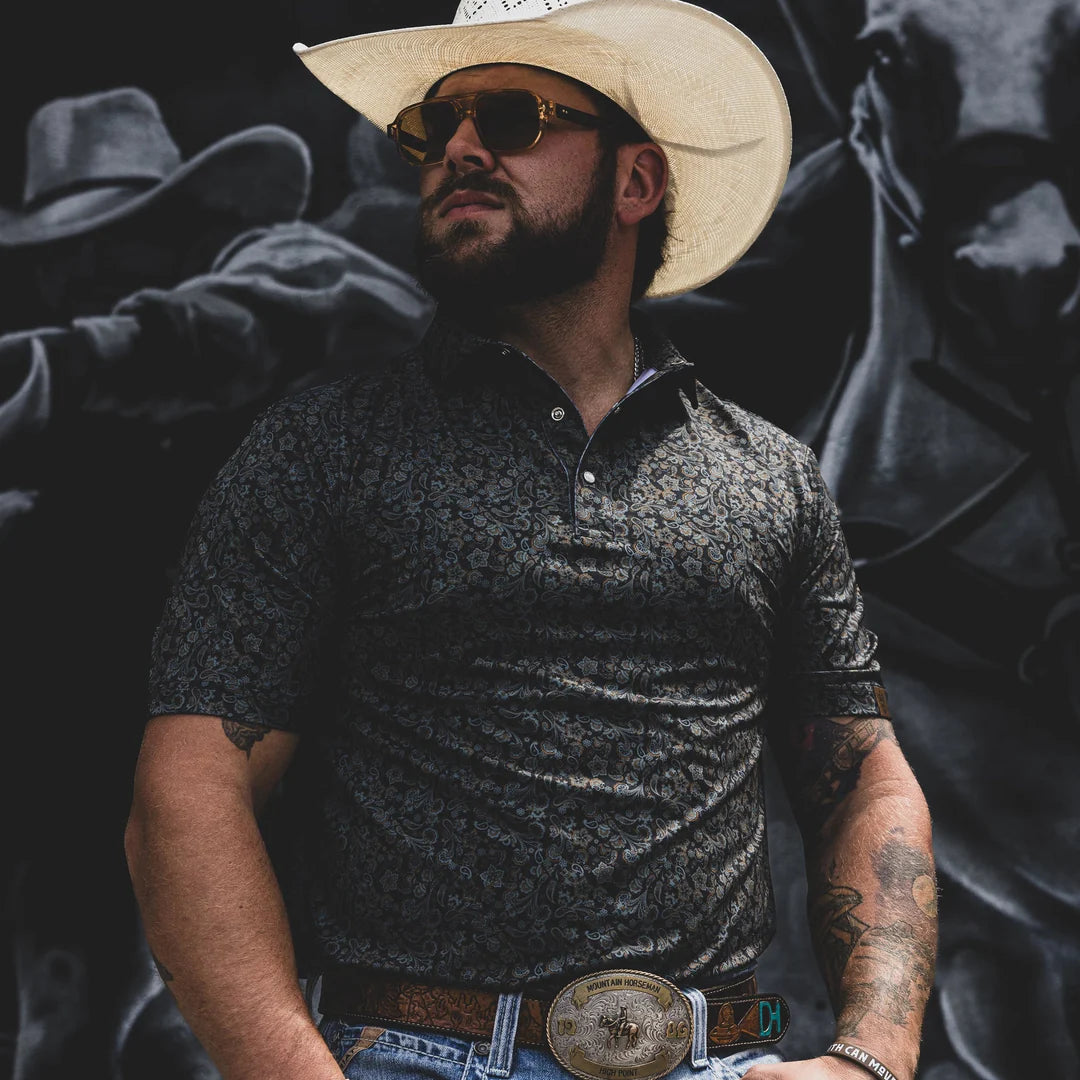
Tough and timeless, this polo is built for the long ride. Featuring a crisp, non-collapsing collar and a rugged, stretchy fabric, it's the perfect shirt for any cowboy's wardrobe.
Rogers and Post were lost.
Reindeer ranchers aside, it would be hard to imagine a stranger place for two cowboys from either side of the Oklahoma-Texas border to be lost in. What were they doing up there, circling around trying to find the end of the world? Rogers and Post had been playing coy with that question throughout their heavily documented air trip around Alaska. With Rogers writing daily dispatches of his voyage for newspapers across the country, and reporters filing national wire stories from nearly every stop the men made in Alaska, little about the jaunt went unsaid, besides its reason for being. The predominant theory, one most reports went with, was that Post wanted to find a new air route to Russia.
However, every time someone asked the two what they were up to, Rogers would have no comment — uncharacteristic, to say the least, for the outspoken columnist.
After hours of circling over the tundra, Post spotted an opening in the clouds and an Eskimo encampment along a bay. He brought the plane down onto the water, and he and Rogers waded over to land and asked a man named Claire Okpeaha for directions to Barrow.
In broken English, Okpeaha told them they were close — just 15 miles away. The men thanked Okpeaha, offered him a cigarette, and returned to the plane. In Rogers’ front breast pocket was his latest column, to be wired to newspapers from Barrow when the duo finally landed. His typewriter — which he’d pound away at while Post flew — was tucked away behind him.
Post fired up the plane’s engine, taxied around, and then thrust forward, lifting off the water with a mighty roar in a steep ascent. The Eskimos then watched in horror as the plane flipped over and crashed back into the water.
After the initial shock, Okpeaha took off running, 15 miles to Barrow, to tell the world Will Rogers and Wiley Post were dead.
No modern equivalent exists today to compare with Rogers’ celebrity in 1935. At a time when print was king, he wrote a brief, daily column that was syndicated in more than 500 newspapers across the country, and he regularly wrote longer exclusives for the major dailies. He was the highest-paid actor in Hollywood and would appear in more than 70 movies, having just completed filming two before leaving for the Arctic expedition (as it happens, his first film was a silent picture called Laughing Bill Hyde, set in Alaska). Franklin D. Roosevelt wasn’t a president to him; he was a friend and contemporary. These were heady heights for the man born in 1879 in Indian Territory (before it was part of Oklahoma) to a prominent part-Cherokee family.
Rogers didn’t set out early in life to be famous. But he did set out to see the world. Rogers left Oklahoma as a young man and tried to make it as a rancher in Argentina. When that venture went bust, he did some work in South Africa, later making the tall claim that he broke horses for the British during the Boer War (fact checkers would say that the dates just don’t line up for that to be possible). But by 1902, barely into his 20s, Rogers began to see the glow of the limelight when he signed on to perform in Wild West shows, first in South Africa and then back in the United States.
Initially, his fame was largely a product of his being a ranch kid from Indian Country. He called himself the “Cherokee Kid,” riding broncs and roping steers for the entertainment of a public enraptured by the American West. He thrilled a crowd in New York City in 1905 when a bull got loose in the stands and he roped it into submission. Others say it was a cow and part of the act, but either way, the dramatic tie-down earned him the thanks of the urban spectators and the praise of major newspapers — his first real brush with fame.
Were Rogers simply a fancy cowboy, his star would have faded like so many others as World War I loomed and Wild West shows lost their allure. But promoters would soon learn the Cherokee Kid possessed a wit sharper than barbed wire, which he presented with no more pretense than a ranch hand talking about the weather while rubbing his sunburned neck. He was deeply political, but never raised his voice when joking about the issues of the day, and was as happy knocking his side as he was the other (concepts that must be entirely alien to today’s political commentators).
“I’m not a member of any organized political party,” went one of his famous quips. “I’m a Democrat.”
After the Wild West shows, he began doing vaudeville. That led to Hollywood and national syndicated press. Throughout the 1920s and into the ’30s there seemed to be little to stop the Cherokee Kid’s ascent to folk stardom.
Rogers contained multitudes, as Walt Whitman might have put it. While he mourned the loss of simpler times and the vanishing frontier, he also championed progress. This central contradiction was on full display during his trip to Alaska.
He was eager to visit Barrow to see a man named Charles Brower on account of Brower’s anachronistic life as a whaler in the 20th century — “I’d rather see him than Greta Garbo,” Rogers told a reporter — and in general feared what statehood would do to the Alaska territory.
“This Alaska is a great country. If they can just keep from being taken over by the U.S., they got a great future,” he wrote in a column published the day before he died.
At the same time, at least part of the purpose of the trip was to show Americans the possibilities that air travel allowed in hopes they’d adopt the new technology.
He took his first plane ride in 1915 in Atlantic City and was immediately enthralled by the technology. When pilot Wiley Post and navigator Harold Getty set a new time record for flying around the world, Rogers immediately championed Post’s cause: expanding commercial flight.
“Post and Getty ... are making this world of ours look the size of a watermelon,” he wrote shortly after the record-breaking flight in 1931.
Post was as much of an American original as Rogers. Born in 1898 in Grand Saline, Texas, just east of Dallas, Post lost his eye working on an oil rig in Oklahoma and used the settlement he got from the company to buy his first airplane. In other words, he wasn’t much interested in his limitations.
Rogers first flew with Post in 1931 following the pilot’s record-breaking flight, as Post was being feted in Oklahoma. In the first of what later seem like eerie premonitions of the accident, Post wrote in a column that, to the one-eyed pilot, “a little thing like fog looks like a clear day.”
To this day, life in Alaska is dominated by three factors: climate, distance, and remoteness. In 1935, before statehood, before WWII and later the Cold War prompted a major military buildup of the territory, and before billions of dollars worth of oil was discovered on the North Slope, the influence of all three on life in America’s last frontier was even more pronounced, which sent Rogers’ imagination churning.
By that time, Post had become the first person to fly around the world solo and was a good friend of his constant champion Rogers. Rogers himself was enjoying greater fame than ever before, as a nation badly beaten by the Great Depression turned to the modest cowboy for his calming wisdom. Rogers was a fierce advocate for Roosevelt’s New Deal polici Source: https://www.cowboysindians.com/2015/07/fifteen-miles-from-barrow/
