
Mid-March in Houston, and it already feels like summertime.
Could be the humidity, but it also could be the body heat: I’m in a record crowd of 80,020 folks attempting to squeeze into Reliant Stadium on the final night of this year’s Houston Livestock Show and Rodeo. Oddly, we’re not here for riding, roping, or barrel racing. We’re here to see the King of Country.
A couple of hours later — after the Randy Rogers Band and Martina McBride warm up the masses with lively sets — the Ace in the Hole Band takes to the spinning center stage and launches a swingin’ instrumental version of “Deep in the Heart of Texas.” I look down to my left and there he is, entering from the floor through a parted sea of fans: George Strait.
The Midnight Troubadour
Tough and timeless, this polo is built for the long ride. Featuring a crisp, non-collapsing collar and a rugged, stretchy fabric, it's the perfect shirt for any cowboy's wardrobe.
The crowd. Goes. Wild.
Yet the country music legend doesn’t take much time to soak in all the love. Dressed in his signature Wrangler blue jeans, button--up, and black Resistol cowboy hat, Strait kicks off what will be an epic, movie-length concert with his 84th Top 10 country single from 2011, “Here for a Good Time.”
“I ain’t here for a long time. / I’m here for a good time.”
The lyrics come off as bittersweet for fans this time around. As do the biographical words to the tune “Troubadour” later on. We’re witnessing the first leg of Strait’s The Cowboy Rides Away Tour. After one more group of as-yet-unannounced dates in 2014, the King of Country will turn in his road-dog card and throw that hat out into the audience one last time before he retires from touring.
While he seems cucumber-cool for most of the Houston show, Strait confirms later in an interview with Cowboys & Indians that there’s much more going on under that hat.
“It’s impossible to describe the feeling of walking out in front of 80,000 people; there was definitely a lot of magic in Reliant Stadium that night,” he says. “It seemed very intimate for such a large place, though.”
Strait’s first Houston Rodeo experience 30 years ago made as big an impact as his latest, even if the crowd at the old Astrodome was less than half the size. The young Texas troubadour famously filled in for a sick Eddie Rabbitt in 1983 and rose to country superstardom soon after. He hasn’t slipped since. According to his longtime producer and trusted friend, Nashville veteran Tony Brown, Strait’s consistency and longevity are what make him extraordinary in the business.
“It has to eventually come to a peak,” Brown says. “I mean, it happened to The Beatles; it happened to everybody. But George, to this day, he’s still active and relevant with these young guys. It’s because he’s never really tried to reinvent himself too much. He knows what he does and he just keeps doing it. It’s all about great songs, and he’s got a real good sense of himself.”
Strait’s recently released album Love Is Everything is his 19th with Brown at the production helm (“There’s not many people that can say they have 19 records with anybody,” Brown marvels). Their run began in 1992 with the massively successful movie soundtrack Pure Country. By then, Strait had already logged nearly a decade of nonstop radio hits that led the way for country’s growing pack of young traditionalists.
With at least two chart hits every year for the last three decades under his buckle, Strait probably faces a difficult task putting together any kind of definitive set list. But so far on The Cowboy Rides Away Tour, he’s been thoughtful about honor-
ing his earliest highlights and telling his origin stories to fans between songs.
“I would have to say the oldies set that we are doing [is my favorite part of this tour],” Strait says. “I start with some songs that I cut the first time I went to Nashville in 1978 that I ended up putting on my first couple of records.”
During the Houston show, he rips through “80 Proof Bottle of Tear Stopper” after telling a story about embarking on that first Nashville trip with songwriter Darryl Staedtler and a “case of Coors beer.” He also gives heavy props to his most frequently employed songwriter, Dean Dillon, when doing “Her Goodbye Hit Me in the Heart” and “Honky Tonk Crazy.” And before giving the couples on the stadium floor one of the night’s many slow-dancing moments during “Marina Del Rey,” he reveals that writer Frank Dycus first presented him with a demo cassette of the song after playing Billy Bob’s Texas in Fort Worth.
Other sections of the set list offer nods to the crossover success of Pure Country (Strait rises from a stool to sing “The King of Broken Hearts,” because “you know Dusty doesn’t sit down.”), more modern staples like “How ’Bout Them Cowgirls” and “Love’s Gonna Make It Alright,” and even a few covers (“Jackson” and “Golden Ring” with McBride, as well as Johnny Cash’s “Folsom Prison Blues” during the encore set).
And then there are those songs that require no setup: The classic rodeo ballad “Amarillo by Morning” brings out thousands of spirited woo-hoos with its lonesome fiddle intro, “All My Ex’s Live in Texas” inspires a stadium-wide singalong, and everyone — really, everyone — feels compelled to stand after “The Chair.”
What’s amazing about hearing Strait deliver his classic songs from the early days is that they don’t sound any different now. At 61, Strait sings like a man in his 20s. Brown’s noticed that, too, and he’s got a theory.
“He didn’t kill his body over the years. I think he drinks Jack, but I’ve never really seen him trashed,” Brown says. “He still looks awesome, he takes care of himself, and he and [his wife] Norma are just always together. He’s a good example for younger artists.”
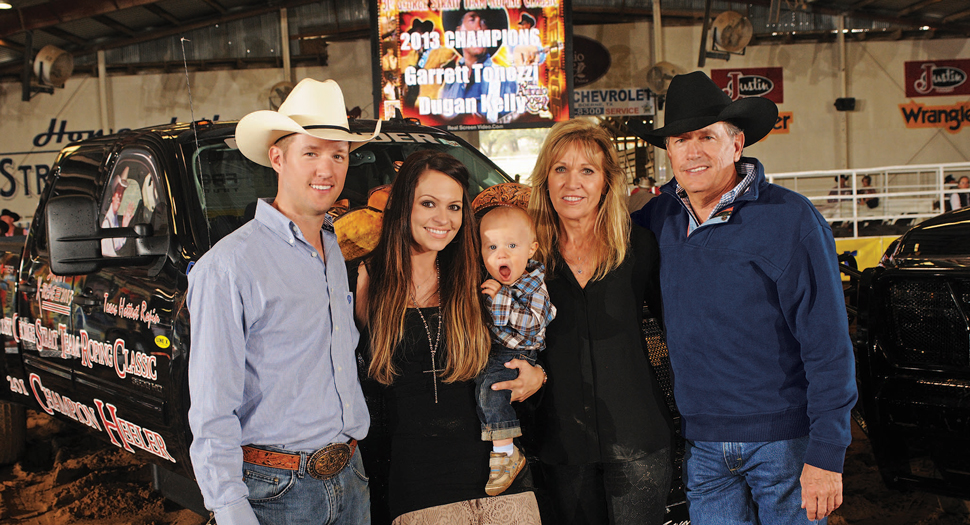
That bodes well for Strait’s post-touring career. He’s promised he’ll keep recording and releasing music. But he’ll also take plenty of time to tend to his favorite outdoor activities — golfing, hunting, fishing, and ranching — as well as his new role as a first-time grandfather to George “Bubba” Strait Jr.’s 1-year-old son, George Harvey Strait III.
“It’s the most wonderful thing,” the singer says of his new namesake. “Everyone that has a grandchild told me how great it was. They were right!”
While Strait is determined to achieve a better balance between work and home life, Brown expresses no fear that the musical output will taper off or be any less exciting than it’s been for three decades.
“When George told me about his plan to stop touring, I said, ‘You know, you could cut a Western swing record, not even thinking about singles,’ ” Brown says. “He’s at the point in his career [where he can do that] as opposed to always going into the studio and thinking about chasing those radio hits.”
A Western swing album would be a brilliant choice for Strait in the future, since he’s done so well to bring elements of that sound into the mainstream over the years. But, for some reason, it’s hard to imagine him not reaching for radio play. For country fans of every age, Strait’s voice goes hand in hand with the radio. It’s a voice that consistently elevates melodies and lyrics. It’ll do so even when the day comes that we can no longer buy tickets to hear it in person.
“I won’t miss all the traveling,” Strait says. “I’m sure I will miss the performing, but like I said, I will still do a few things.
“It’s going to be a big adjustment for me for sure. We’ll see how it goes.”
Cowboys & Indians: This is your final tour, but you aren’t giving up music altogether. Tell us about the new album, “Love Is Everything.”
George Strait: I still want to do a few events throughout the years, but just no more touring. I will still be making records. I thought Love Is Everything was the perfect title just because it is everything, isn’t it? My son and I, along with my friend Dean Dillon, wrote a few of the songs on the record. I also redid a song that I wrote around 1976 [“I Just Can’t Go on Dying Like This”]. I think it turned out great.
C&I: Who are some go-to artists that you can always count on to improve your mood?
Strait: I listen to all kinds of music, not just country music, which might surprise some people. But at the end of the day, I gotta have some Hag, Jones, or Wills. Merle Haggard was my hero and may be the biggest influence on my career. While I was in the Army stationed at Schofield Barracks in Hawaii, he came and played at
Source: https://www.cowboysindians.com/2013/07/george-strait/
