
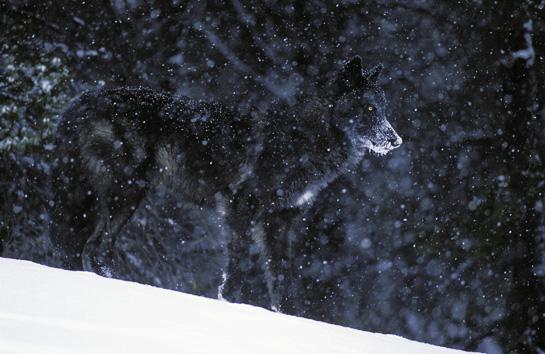
Wolves make their living in the most remote places on the planet. They’re big, tough, and crazy smart. With few exceptions, almost every wolf taken during recently opened seasons in Idaho and Montana has been killed incidentally by a hunter who happened to have a wolf tag in a pocket when he was out hunting something else.
Only a handful of hunters in North America can claim to be expert at consistently taking wolves without the aid of traps or a pack of hounds. Here, three of the best give the inside scoop on how you can better stack the odds in your favor this season.
**
DISTRESS CALLS**
In the province of Alberta, Canada, wolf tags are cheap, the season is long, and the bag limits are unlimited. Brad Fenson, a habitat development coordinator for the Alberta Fish & Game Association, says that he usually sees at least one wolf each hunting season.
The Midnight Troubadour

Tough and timeless, this polo is built for the long ride. Featuring a crisp, non-collapsing collar and a rugged, stretchy fabric, it's the perfect shirt for any cowboy's wardrobe.
“Most of the time,” he says, “I see them coming right in when I’m trying to call something else.”
Fenson has hunted all over the Canadian Far North and has seen just about every method used to consistently lure wolves into rifle range. But for sheer excitement, he ranks predator calling as the most challenging and exhilarating tactic.
“A couple of years ago, in northern Alberta, I was trying to call moose with a partner,” he recalls. “We were having trouble with wolves all week. They would come in and start howling. It really shut us down.”
Fenson and his partner decided to turn the tables on what turned out to be a pack of 12 animals. Setting up with a crosswind on the edge of a frozen lake, Fenson hit the cow call, and a big, black alpha male soon appeared on the far bank less than 70 yards away.
“When we shot, the rest of the pack had no idea what had happened,” he says. “They started running back and forth in front of us and we shot five of them, some as close as 10 yards.”
The best advice for calling wolves is to not give up too soon on a stand location where you’ve consistently located sign.
“Wolves tend to run a circuit to work their territory,” he says. “It might take the pack days to return to the same area, but if you can call day after day in a place where you never fail to find tracks, eventually those animals will be in a position where you can call them.”
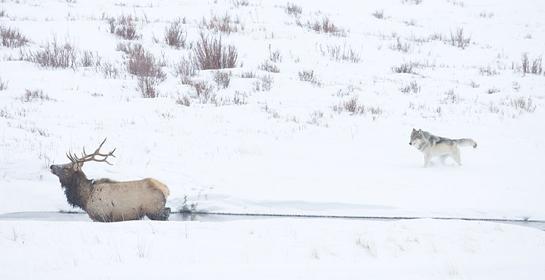
While Fenson has found that wolves will respond to a moose or elk call at almost any time of day, he prefers to hunt “the shoulder hours”–early morning and just before dark. In areas where wolves are preying on elk and moose, a cow elk bleat and a moose calf bawl are the only sounds you need.
“I’ll always set up on the edge of an opening” he says, “like a small meadow or a frozen lake where I can see at least 100 yards. You want good visibility, and I always prefer a steady crosswind to help avoid detection.”
**
BAITING**
Wisconsin and Minnesota were hammering out the details for the first wolf hunts to be held in those states, one of the biggest provisions under scrutiny was whether or not hunters would be allowed to use bait.
American hunters are familiar with traditional techniques of baiting. It’s effective and–when talking about hunting bears–sometimes it’s the only practical method. But according to Ontario’s Peter Martin, the standard technique that requires a hunter to patiently wait out the daylight hours in a stand overlooking the bait just doesn’t work for wolves.
“For baiting to work,” says Martin, “you really don’t want to be set up too close to an active bait site.”
Martin admits this probably sounds counterintuitive. But few can argue with his 20-year track record of getting hunters that once-in-a-lifetime crack at a wolf. The owner of Kapriver Retrievers & Outfitters (kapriveroutfitters.ca) is a wolf-baiting master with hundreds of happy clients.
“We’ve tried to sit hunters in full view of the bait, as far as 250 to 300 yards across a frozen lake,
