
It was a magnificent Easter Sunday morning when canoe guide Phil Longden led his party of German tourists into a channel skirting the great Zambezi River, which separates Zambia and Zimbabwe in southern Africa. Their trip had been a happy one and the spectacles they had come in search of had filled their cameras. The vista ahead promised more of the same. Waterbuck and impala grazed quietly on the green riverine grasses while brilliant white egrets danced at the feet of Cape buffalo as their hooves unearthed a well-stocked larder of insects. Unmistakable brown blobs rippled the calm water downriver as hippos grunted and chortled. On the sand banks crocodiles basked in the sun, languid but alert.
Longden was tall, with an Olympian physique. No newcomer to these waters, he had coursed the big river in his fiberglass shell many times. The Zambezi practically ran in his veins. He loved the sweaty smell of the “Dagga Boys,” the old buffalo that glared back at him when he paddled by their retirement homes on the islands. And he loved the scenic magnificence of the floodplain that lay at the feet of the rugged mountains that formed the Zambezi escarpment.
The Midnight Troubadour
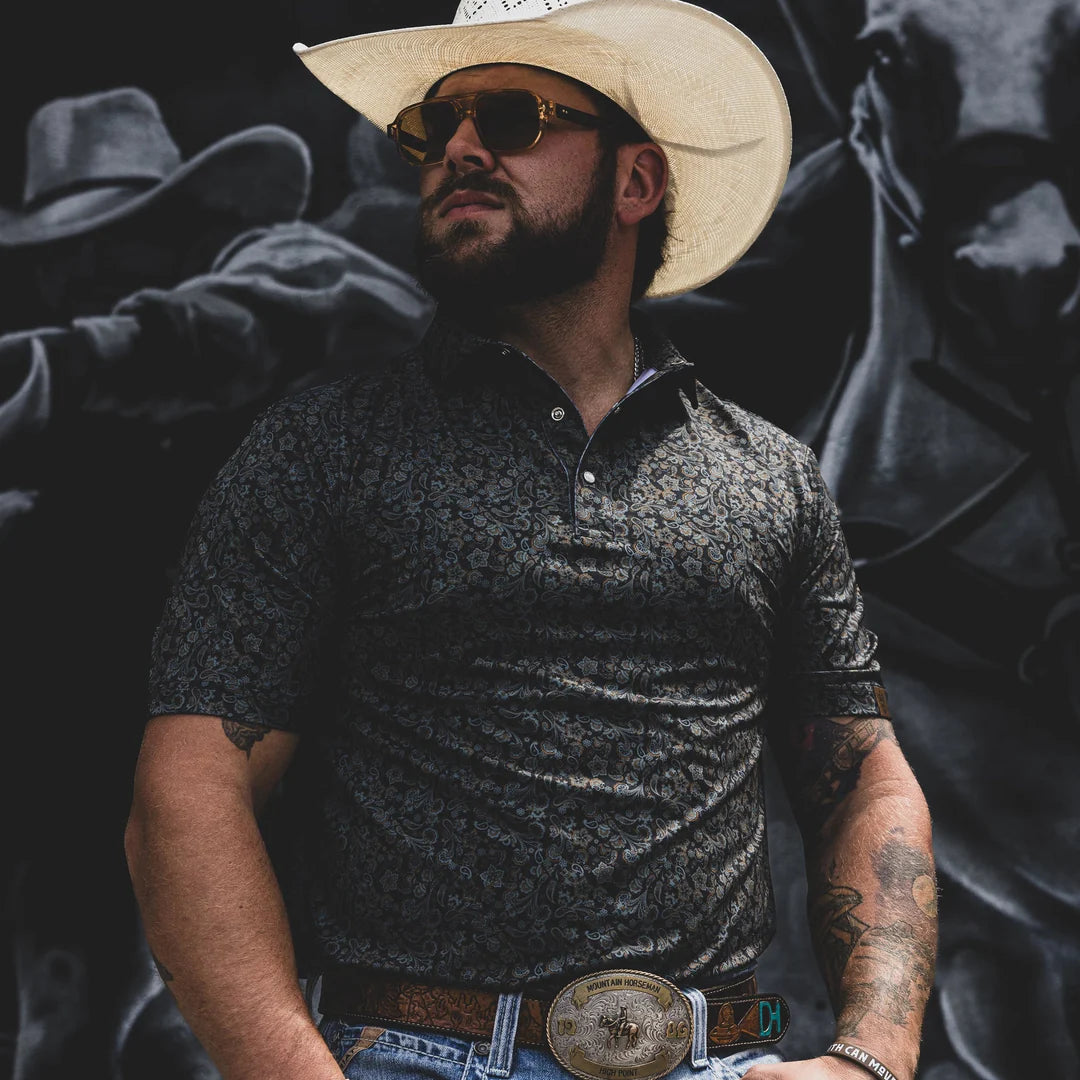
Tough and timeless, this polo is built for the long ride. Featuring a crisp, non-collapsing collar and a rugged, stretchy fabric, it's the perfect shirt for any cowboy's wardrobe.
That morning Longden had called the little flotilla together to relax and savor the beauty. He organized a “leg-over,” where the occupants place their feet in the adjoining canoe to hold the canoes parallel. The group rested their paddles and sat back to relax and let the current take them slowly down. The tranquil scene was shattered when an unseen hippo burst out of the reed-bank adjacent to them and crashed into the water. The guide reacted immediately and shouted for the paddlers to disengage.
“Watch out!” he screamed as he kicked a canoe away. But as he drew his foot back, a pair of gaping jaws with massive white incisors surged out of the water below and clamped onto his leg. With awesome brute strength and four tons of muscle and bone, the attacking hippo shook Longden like a rag doll, tearing into his flesh and bone.
The guide struck out at the attacker with his paddle but was pulled into the river and dragged down. Terrified, the entourage screamed and lashed out at the water with their paddles. Miraculously, Longden surfaced. He was immediately pulled aboard another canoe and hauled to shore. His lower leg was a bloody mess of lacerations, still connected to the top half, though tenuously. Part of his leg was numb, but Longden felt a searing pain above the knee. The guide looked at his mangled leg and knew that a few disastrous seconds had changed his life forever. Then the scene was quiet again. Amid the chaos, Longden noticed his blue paddle drifting slowly away. He was sad to see it go; it had been with him all the time he’d been on the river and he felt like he was seeing the last of an old and trusted friend. He looked up at the big blue African sky and felt sadness overwhelm him.
On this same Easter Sunday, a party of five people were on their way from the Zambian capital of Lusaka to a camp about a hundred miles downriver from where Phil Longden lay stricken. They were on their way to relax and fish and had no idea of what had just transpired.
The group consisted of Alistair Gellatly, Arthur and Fay Taylor and Fay’s parents, Clive and Brenda Kelly, who were visiting from England. Both Gellatly and Taylor were professional hunters who were taking time off to relax for a few days and fish the Zambezi. They were both hard men who had spent years in the bush.
Mayday, Mayday!
On Tuesday morning they were aboard their powerboat, just up from the Mupata Gorge, in the middle of the river drifting for Tiger fish. It was another perfect day; the sun shone brilliantly and not a soul was in sight. Elephants frolicked on the north bank, and to top it all off the fish were biting. Life could hardly have felt better. That was about to change.
Suddenly there was a thunder-clap and the boat’s prow exploded out of the water, sending the party sprawling into the stern. The boat was at a precarious angle, and another thud capsized them. In seconds they were in the water, swimming for their lives. For some strange reason a lone hippo had decided the boat was unwelcome and had attacked it. They saw their assailant only briefly as he snorted contemptuously, submerged and disappeared. All of them knew instinctively that they were smack in the middle of the river, at a point where the crocodiles ruled. Worse still, Clive and Brenda Kelly could not swim.
Taylor was a strong man and an excellent swimmer. He and his wife grabbed Brenda and swam for the nearest sand bar. Gellatly and Clive managed to grab a rope trailing from the boat, which had settled in the water with its hull inverted. They climbed on top and found a semblance of sanctuary. Meanwhile, Taylor and his wife battled the current to reach the sandbar as Brenda hung on for dear life. Fear drove them on. Exhausted, they made it to the shallows and staggered to the center of the little island.
Once he had recovered his breath, Arthur launched himself back into the river and swam back to the boat. With Gellatly’s help he then managed to get Clive back to the sandbar. It was midday and the sun was beating down. Their situation was desperate. They could wait and hope for another boat to pass by, but on this remote stretch of river there were no guarantees.
Gellatly and Taylor also knew that the river level was dictated by the floodgates at the Kariba dam 200 miles upstream. If those gates were opened, the river would rise and their island sanctuary would disappear, leaving the party no choice but to swim for it.
Gellatly decided that the best way to get help was for him to swim to the bank and run to a nearby fishing camp, about 5 kilometers away. He was well aware that his swim might cost him his life, but he was the only single man in the party; his great friend Arthur had a wife and family. He dove into the river and swam for the riverbank.
Two hundred meters of water flowed between life and potential death.
Into the River
A smoker and a lover of beer, Gellatly was not exactly a fitness fanatic, but he pounded the water for all he was worth as he struggled to narrow the gap. Breathless, and after what seemed a lifetime, he finally touched the bank.
He frantically tried to extricate himself. He clawed at the soil and tried to clamber up, but to no avail. The side was too sheer. Out of breath, his strength sapped, he looked upriver and saw an inlet. He swam toward the opening and entered the calm water, observing with relief that the land joined the river at a gentler grade here, which would allow him to exit the water more easily. He swam briskly through the mirrorlike calm. It was deadly quiet around him. Looking up, he realized why. Directly in front of him the armor-plated head of a crocodile lay motionless on the water.
Then a gentle ripple formed a small bow-wave around the croc’s snout as the huge reptile began to come alive. Gellatly waited motionless, knowing the croc would take him down into the dark depths and tear his body apart. With nowhere to go, Gellatly dove. In a second the crocodile attacked; Gellatly was winded by the body blows that hammered into him. The big man kicked and punched in a furious panic in the dark. Somehow he kept the teeth at bay but the crocodile stayed close and circled him eagerly, looking for a limb to grab hold of. Then suddenly the croc was gone. Gellatly surfaced, gasping for air. For a brief moment there was quiet. Then all hell broke loose as Gellatly felt the full length of the crocodile’s body thrust against his as it powered out of the water and fastened onto his right arm at the elbow. Down he went again. This time he knew what was coming and made the only move he could. The old hunter knew the croc would launch itself into a tail-driven sp
Source: https://www.outdoorlife.com/articles/hannes-wessels/2007/09/terror-zambezi/
