
PRESSED TIGHT to the starboard gunwale of his guide’s deep-V, anchored in the dirty roil of a rain-swollen river, retired cop Jeff Puckett powers through a racking lesson on leverage.
Calves straining, forearms burning, back aching, and with a purple bruise spreading low on his belly from the butt-end of a surf rod, Puckett applies more force to his side of the lever, but the object on the other end barely budges.
“It’s like dragging for a sunken car,” he grunts, grinning over the pain.
In mid snicker, Puckett’s dad, Gary, who has been sweeping his rod in wide arcs across the boat’s port side, suddenly sticks a fish of his own. Now the elder Puckett is learning all about leverage, too.
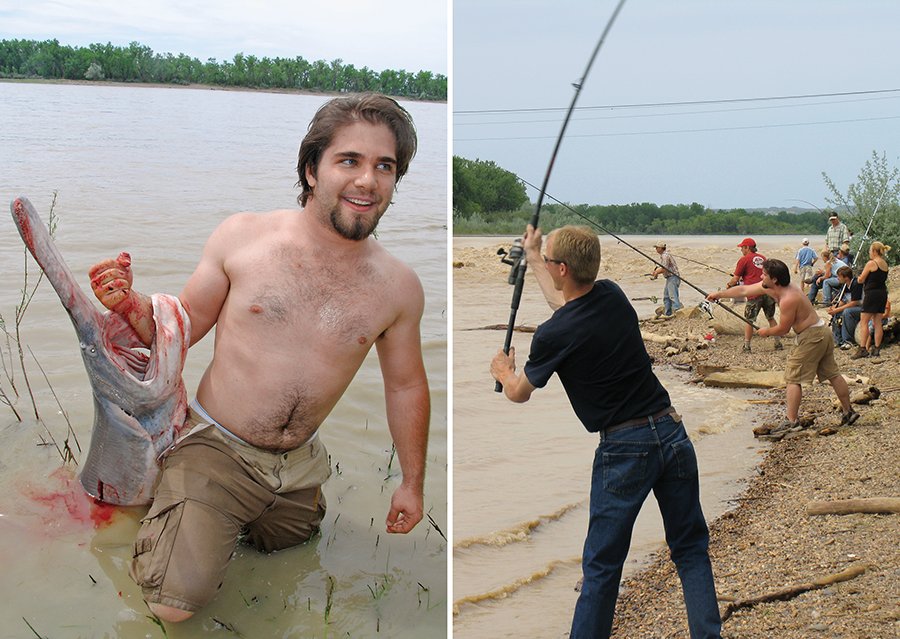
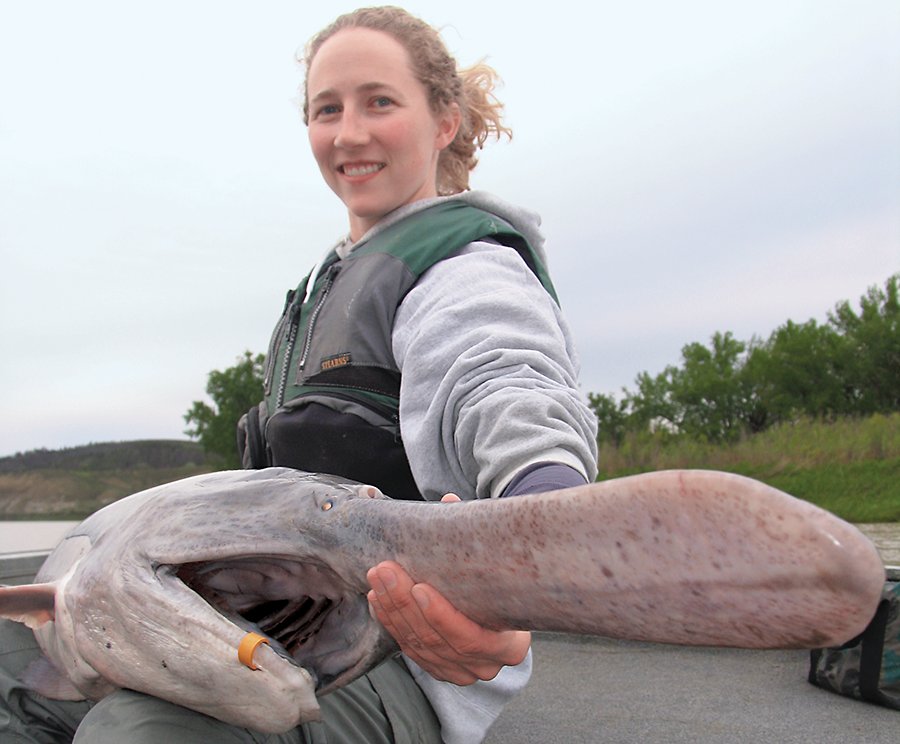
Father and son gradually winch their loads—two 40-pound paddlefish, each with a treble hook buried in its side—across the current, up to the surface, and back to the stern, where the guide hoists them aboard. Both fish are spawning females, bellies distended with shiny black eggs.
Those ova have come to symbolize both life and death for this species.
Each dark capsule contains genetic coding, DNA-borne traits that have allowed paddlefish to survive since the Mesozoic Era. In the slow chaos of time on Earth, flora and fauna come and go, emerge and then pass into oblivion. Yet this unique life form has been reproducing itself with few evolutionary changes for 75 million years.
But paddlefish roe also has another notable use—as an hors d’oeuvre served on toast points. And that’s where this fishing story gets messy.
Since the Pucketts are in Oklahoma, they’re not allowed to keep the full bounty of eggs from their catch. To remain within the law, Jeff and Gary are required to throw away most of the roe—or, alternatively, donate all of it to the state, which processes and sells paddlefish caviar worldwide, collecting some $2 million a year.
Officials say it’s all about fisheries research and salvaging a byproduct to generate supplemental funding for conservation.
The Midnight Troubadour

Tough and timeless, this polo is built for the long ride. Featuring a crisp, non-collapsing collar and a rugged, stretchy fabric, it's the perfect shirt for any cowboy's wardrobe.
Critics call it heavy-handed government. They worry about commercialization and market-driven poaching of a relatively fragile native species. And they question whether a fish-and-wildlife agency is exploiting a public-trust resource for a different kind of leverage, in which paddlefish are the lever and the object at the far end is profit.
Commercial exploitation of wildlife is what condemned many of America’s game species to decades of overharvest, these critics say, and gave rise to the establishment of state game agencies a century ago. Do we really want to go back to putting a dollar value on wild species?
GRAY GOLD
THE “CHEVROLET OF CAVIAR,” according to chef Wolfgang Puck, paddlefish eggs have been commercially available for more than a century, though traditionally they’ve been shunned by connoisseurs. Favor went to beluga sturgeon from the Caspian Sea. Their gleaming eggs, called pearls, are larger and firmer, with a sumptuous “pop” of flavor when pressed between the tongue and roof of the mouth.
But demand for the delicacy gradually outpaced supply. As beluga caviar grew scarcer, retail prices in the U.S. soared to $300 an ounce, fueling rampant overharvest, both legal and illegal.
“Throughout the world, the history of caviar is the history of fish population exploitation,” said Brad Schmitz, a Montana Fish, Wildlife & Parks Department fisheries manager, in a 2007 interview. “If caviar stocks are not tightly regulated, the fish population can eventually disappear.”
Exhibit A is the Caspian Sea’s beluga, where sturgeon numbers finally tipped into an actionable nosedive. International trade in wild beluga caviar was restricted in 1996 under the governance of the Convention on International Trade in Endangered Species (CITES) and banned entirely in the U.S. in 2005.
All of which caused aficionados worldwide to take a second look at the prehistoric, odd-looking fish from the Mississippi River basin.
CLASS OF ’99
SOME 450 RIVER MILES from the main stem of America’s big river, in the hilly uplift of the Ozarks in northeast Oklahoma, is Grand Lake. Nourished by two main tributaries, the 46,500-acre impoundment is the state’s most productive paddlefish fishery.
In 2004, technicians with the Oklahoma Department of Wildlife Conservation (ODWC) were conducting routine netting surveys to assess fish populations in Grand when they discovered a significant change from previous years. Nets were suddenly laden with five-year-old paddlefish.
It was the first evidence that unprecedented spawning success had occurred in 1999. Biologists are unsure exactly what caused the huge spike in productivity, but they knew right away that a massive year-class of paddlefish was just two to three years away from reproductive age.
 https://www.outdoorlife.com/articles/fishing/2015/03/egg-takers-harvesting-americas-paddlefish-caviar/