
This is the first in a series of what we’re calling NLU Special Projects. In each edition, we’ll do a deep dive into one particular topic, unpacking it in ways you may not have considered previously. This piece was conceived as a podcast — and we’d encourage you to listen to it in that format — but we also wanted to make a print version available for all you luddites out there.
For our inaugural episode, we explore the Tall Tales of Gary Player.
Thanks for reading and listening.
Morning, Damon!
In 2015, The U.S. Open was held in the Pacific Northwest for the first time in its history. The venue was Chambers Bay, a public course designed by Robert Trent Jones Jr., that was built on top of a sand-and-gravel quarry, on the shores of Puget Sound. A links-style course with little rough and even fewer trees, it represented a dramatic departure from the tournament’s recent traditions. The fairways were muted and brown; the tall, wispy grasses that lined the course’s numerous bunkers were a stark change from the U.S. Open's typically suffocating rough. From the highest point on the property, you could see miles of calm blue water and sky.
The Midnight Troubadour
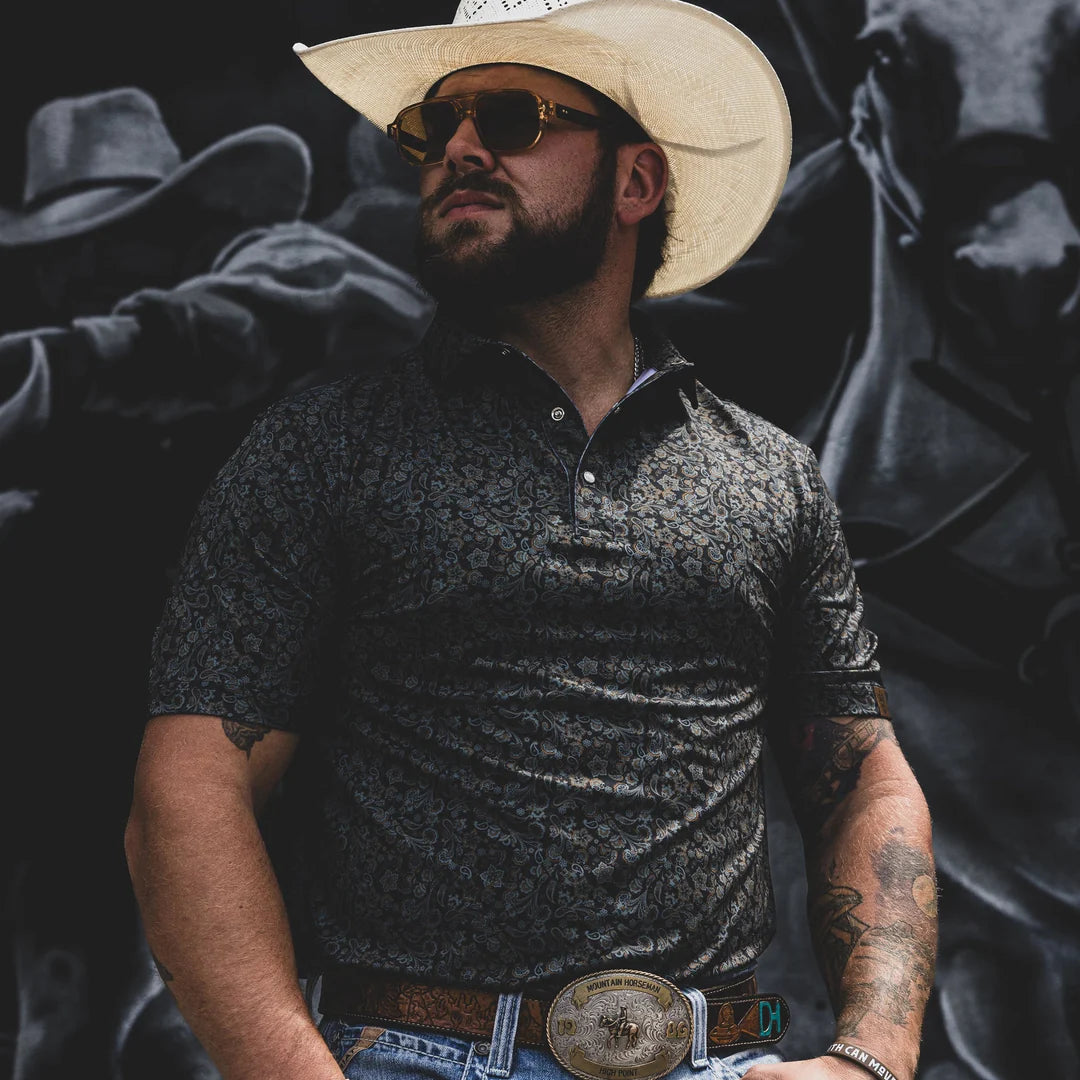
Tough and timeless, this polo is built for the long ride. Featuring a crisp, non-collapsing collar and a rugged, stretchy fabric, it's the perfect shirt for any cowboy's wardrobe.
Despite the fact that the tournament boasted a star-studded leaderboard, and that it was ultimately won by one of golf’s rising stars — 21-year-old Jordan Spieth, who just a few months prior had won the Masters — reviews of the course were decidedly mixed.
Henrik Stenson said the greens were like putting on a field of broccoli. Rory McIlroy said a round at Chambers Bay felt like you were playing on the surface of the moon. Several players described the conditions, particularly the greens, as a disgrace and said the USGA should be ashamed.
But the harshest criticism of the course came from someone who wasn’t even competing in the tournament. On Saturday morning, prior to the third round, Damon Hack and Gary Williams of the Golf Channel welcomed nine-time major winner Gary Player to the show, eager to get the 80-year-old Hall of Famer’s thoughts on the peculiar U.S. Open that was currently unfolding.
Player, who did the interview remotely from Chambers Bay’s driving range, was grinning as the camera cut to him. There was no indication he was about to unleash one of the most famous course critiques — and diatribes — in modern history, particularly after Hack opened with easily the most benign question to ever inspire a 7-minute monologue:
“Good morning Mr. Player, how are you?”
Morning Damon! And morning Gary! I’m standing in the most beautiful state in the world. Washington. Seattle here. Unbelievably beautiful. And we’re playing the U.S. Open, this great championship. A group of people that I have great respect for. But this has been the most unpleasant golf tournament I have seen in my life. I mean the man who designed this golf course had to have one leg shorter than the other! It’s hard to believe that you see a man miss the green by one yard, and the ball ends up 50 yards down in the rough. And can you imagine? This is a public golf course. This is where we’re trying to encourage people to come out and play and get more people to play the game. They’re having a putt from 20-30 foot and they’re allowing for 20 foot right and 20 foot left. I mean it’s actually a tragedy.”
He continued for several more minutes, invoking his desire to save the environment, to save amateur golf, to save marriages by helping husbands return home sooner to their wives, but it was Player’s hyperbolic use of the word “tragedy” that would stick with me and my friends.
It was so absurd, we couldn’t resist taking it even further, inventing a parody of Gary Player where nothing felt off-limits. By week’s end, I’d re-imagined his monologue in a cringe-worthy South African dialect, pretending he’d called the course “Chambers Bay of Pigs” and that it was basically “the 9/11 of courses.”
By 2015, golf media was in the midst of a seismic shift, though few people fully understood it at the time. Newspapers were slashing travel budgets; the make-up of the press tent was rapidly changing. Younger voices, many of us buoyed by our Twitter followings, were filling the void with humor and irreverence, and raising a new generation of golf fans on a steady diet of podcasts. Virtually none of us had been alive during Player’s prime.
I was an exception, but only technically. When he won the 1978 Masters, his ninth and final major, I was three months old.
For that reason — and a dozen others — we did not view him with the same reverence we did Arnold Palmer or Jack Nicklaus. Player was a curiosity, a Paul Bunyon-esq figure more famous to our generation for appearing naked on the cover of ESPN The Magazine than he was for winning any of his majors.
When I began appearing regularly as a guest on this podcast, Soly couldn’t resist goading me into sharing my Gary Player caricature with the audience. The goofball in me who grew up idolizing the impressions done by Dana Carvey and Phil Hartman was happy to oblige. Everything that came out of my mouth felt a little ridiculous, and increasingly cringe, but none of it felt dishonest.
(Here are the receipts.)
KVV: That take was despicable, Porath! I can’t believe you would call out Jordan Spieth like that and say he lacks pop!
Soly: What about the crowd? What did you think of the crowd Mr. Player?
KVV: The crowd was horrendously spirited! And tragically into it! Hopefully next time they have a Ryder Cup in the United States – I personally never played in a Ryder Cup, but if I did, I would want Fatty Patrick Reed to lose a few pounds and play with me, he would be a great partner, if he took on my gluten free diet.
I wasn’t mocking Player so much as I was embracing a version of him that felt spiritually true, even if in reality, it was more like the kind of SNL skit they air just before 1 am.
Soly: Last one, I want to get your thoughts Mr. Player on CBD oil. It seems to be all the rage on the circuit. Have you dabbled in it at all yourself?
KVV as Gary Player: CBD oil? I’ve never heard of such a thing. Sometimes I’d go to the garage and take a little sip of motor oil and say how tough is Gary Player? Let’s see if he can just process this right through or if he’ll be rolling in pain and lose five more pounds that he can’t drop.
Besides, it was hard enough to discern where the line between fact and fiction existed for Player. Early in his career, he would boast that he did 300 crunches every morning as part of his routine to stay fit. Later on, that claim rose to a thousand crunches four times a week. In his 80s, he insisted, with Orwellian certainty, the routine had always been thirteen hundred per day. In 2022, he told the New York Times he’d shot his age or better Twenty-four hundred (2,400) times in a row. In 2023, he told the same story to the Palm Beach Post, only now he claimed that number was three thousand and seventy two (3,072) times in a row.
It wasn’t that Player was lying — framing it that way felt nefarious — but it reminded me of a passage in one of my favorite short stories, Tim O’Brien’s Sweetheart of the Song Tra Bong, a meditation on war and storytelling.
“It wasn't a question of deceit,” O’Brien wrote. “Just the opposite: he wanted to heat up the truSource: https://nolayingup.com/blog/the-tall-tales-of-gary-player
