
After finally claiming the crown of Middle Earth in the spectacular conclusion of the Lord of the Rings trilogy, Viggo Mortensen is all saddled up and raring to gallop across the Middle East in Hidalgo, an epic adventure about an American cowboy who pushes himself and his horse to punishing extremes during a long-distance race across the Arabian Desert.
Mortensen stars as Frank T. Hopkins, a real-life horseman and alleged hero who claimed to be, among other things, a U.S. Cavalry dispatch rider, a star of Buffalo Bill’s Wild West Show, an endurance rider of legendary accomplishment — and the son of a Cavalry scout who miraculously survived the Little Bighorn massacre. At first glance, the character might seem worlds away from Aragorn, the stoic warrior Mortensen played so memorably in Peter Jackson’s films of J.R.R. Tolkien’s fantastical novels. But the actor suggests that differences between the two roles may be more apparent than real.
check out our premium collection
“To be honest with you,” Mortensen says during an afternoon of thoughtful conversation, “Aragorn reminded me a lot of the Western characters I’d seen Gary Cooper play — his way of reacting to certain circumstances and thinking before he acted. Also, Aragorn had a certain code of honor that’s not unfamiliar if you’ve looked at Westerns.
The Midnight Troubadour
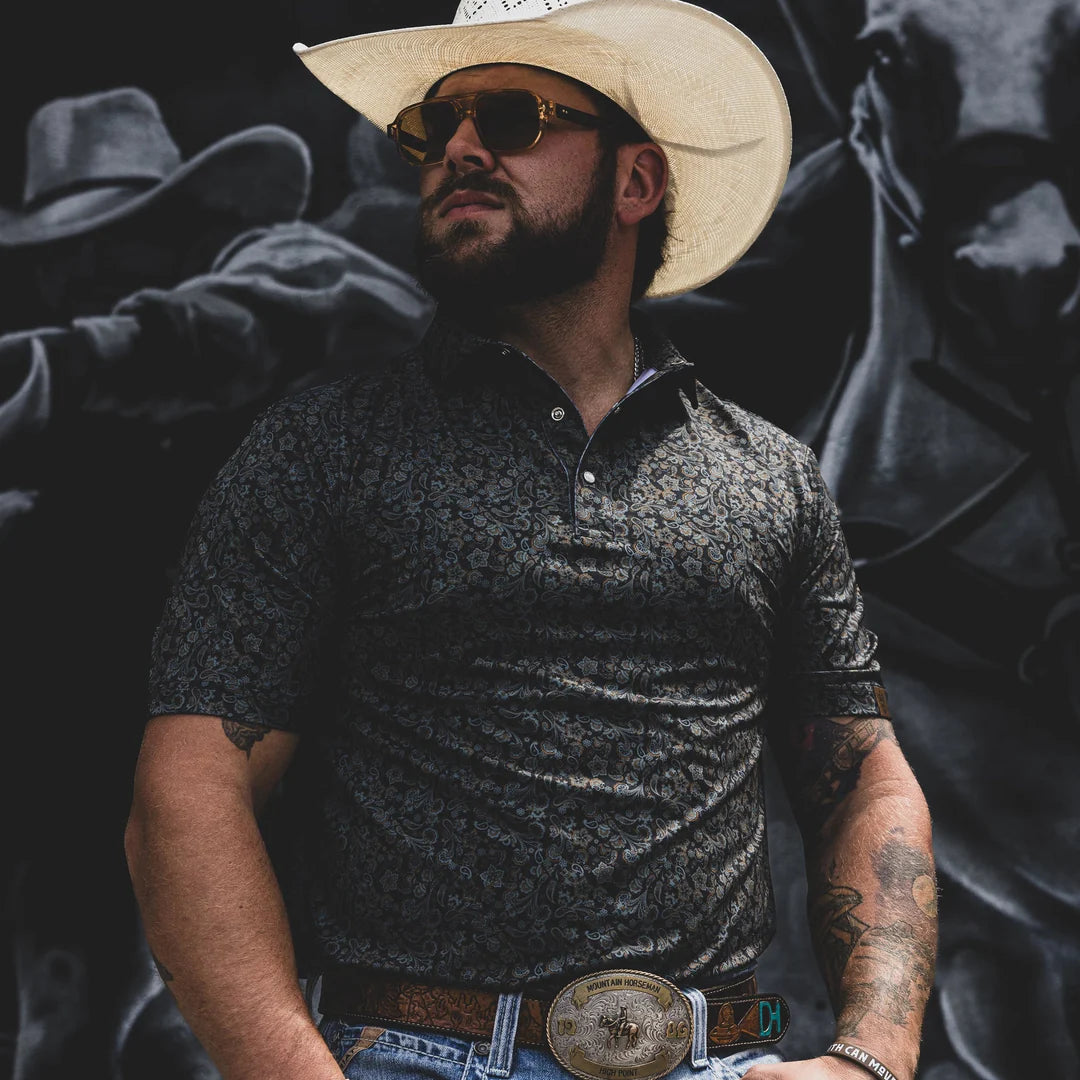
Tough and timeless, this polo is built for the long ride. Featuring a crisp, non-collapsing collar and a rugged, stretchy fabric, it's the perfect shirt for any cowboy's wardrobe.
“Of course, that’s not just particular to Westerns. When you think about it, it’s no accident that someone like Akira Kurosawa, the great Japanese director, would make movies about samurais that were a lot like Westerns and were in fact then remade as Westerns. The Magnificent Seven had a lot to do with Seven Samurai, and A Fistful of Dollars had a lot to do with Yojimbo. I think the Lord of the Rings movies have many of those same qualities.”
Hidalgo introduces Hopkins by noting his celebrated triumphs as an endurance rider — including, most famously, his victory in an 1886 long-distance race from Galveston, Texas, to Rutland, Vermont — and detailing his brief career as a star attraction in Buffalo Bill’s traveling revue. But these adventures serve merely as prologue to Hopkins’ death-defying exploits during the 1890 running of the Oceans of Fire race along the gulf of Syria. At the behest of a sheik (Omar Sharif) with a penchant for high-stakes wagering, Hopkins agrees to test Hidalgo, his favorite Mustang, against more than 100 desert-bred steeds in a 3,000-mile run for fame and fortune. For nearly 10 weeks, the American cowboy and his pinto stallion endure broiling heat and occasional sandstorms, often going for one or two days without water. Near the end, Hopkins seriously wonders whether the finish line will ever be more than a taunting mirage.
“It’s not your usual Western,”Mortensen says, “in the sense that most of the action takes place in the Arabian Desert. But like many Westerns — like many stories from many different cultures — it’s a hero’s journey, a classic hero’s story.
“Whether you’re talking about a Viking legend or The Odyssey — or a Western — you’ve got a character who has a challenge presented to him. Sometimes it’s an opportunity; sometimes it’s a situation that you can’t get out of. Either way, you’re put in a position where you’ve got to go to unknown places and face unfamiliar people. And the story becomes, in large part, how you react to this challenge as a person.”
In other words, Mortensen says, it’s about how a character is formed in a very stressful situation, which is ultimately even more important than whether he achieves the goal or survives the journey. Those kinds of stories have always interested him, as does the opportunity to portray a character who transcends physical limitations and burdensome self-doubt. As Frank T. Hopkins, Mortensen felt he could ultimately appear every bit as heroic as any larger-than-life adventurer in the wilds of Middle Earth.
“It’s always intriguing to have a character who is in many ways reluctant or unsure about whether he wants to go on the journey or whether he’s up for it,” Mortensen says. Hopkins initially leans toward the excuse that his horse might not be up to it. By this time, he has a lot of races under his belt, but he hasn’t raced for a while. “These are all excuses that a person makes in life to avoid facing up to certain challenges,” Mortensen says. “Of course, there isn’t anything that says you have to accept every challenge that’s offered to you. But in this case, it’s one in which the character stands to learn a great deal and risk a great deal.”
Even before the first chapter of the Lord of the Rings trilogy thundered into theaters in 2001, Mortensen was branded a hot property by Hollywood decision makers. He made his movie debut as a minor character in 1985’s Witness, then served his apprenticeship as a mostly anonymous supporting player in movies as diverse as Young Guns II (his only other Western credit) and The Young Americans (an underrated British-produced crime drama that went the direct-to-video route in America). In 1991, he earned praise from critics for his breakthrough performance as the violently hotheaded brother of a Nebraska highway patrolman in Sean Penn’s The Indian Runner. Mainstream audiences were equally impressed with his magnetic screen presence — and, quite often, his smoldering-hunk sensuality — in The Portrait of a Lady (1996), G.I. Jane (1997), A Perfect Murder (1998), and 28 Days (2000).
And as soon as the masses started swooning while he swung a terribly swift sword as Aragorn, Mortensen’s employment opportunities increased exponentially. Even so, director Joe Johnston (October Sky) had little trouble talking him into signing on for the rigors of Hidalgo— a movie that required months of location shooting in Morocco, California, the Black Hills National Forest in South Dakota, and the Blackfoot Indian Reservation in Montana — once Mortensen read what he describes as the “terrific script” by John Fusco (who,perhaps not coincidentally, also wrote Young Guns II).
“I’ve always liked adventure stories,” Mortensen says, “because they’re filled with risk and danger. And I like horses. And I’m fascinated by that period, the late 19th century. It’s a really interesting period — throughout the entire world, of course, but especially in America. It was a time of great transition that really marked the end of the frontier in a way, the end of the Wild West. And it marked the beginning of a time when America started looking outward at the rest of the world and thinking about its place in the world.
It was a pivotal time in history — after the Civil War, before World War I, just before the Spanish-American War — one that gets Mortensen’s imagination going. “I’ve always wondered what it might be like to eavesdrop on a period like that and glimpse those historical events,” he says. It’s not just the history he’d like to see, but also the birth of a myth. And not just the myth of the West, but the myth of America.
“Some people will tell you, ‘Oh, a myth is just a lie, and it’s a way of hiding the truth.’ And sometimes that is true. Sometimes people use myths and tall tales to hide what really happened. But in other cases — like in the case of Hidalgo, certainly — myth serves to heighten events in order to bring attention to things that really happened but that have been neglected or misreported.”
Mortensen is among the first to admit that oft-told stories about the adventures of Frank T. Hopkins are, at best, dubious. At worst, the tall tales are complete fabrications. Historians and researchers have devoted copious amounts of time and energy to books, articles, and websites that debunk many of Hopkins’ more fanciful claims. According to them, Hopkins wasn’t born in a log cabin near Fort Laramie, Wyoming, as he often claimed, and he didn’t live among the Lakota Indians, star in Buffalo Bill’s Wild West Show, or even ride in the Oceans of Fire race. Indeed, some of the most iconoclastic critics make the claim that, in all likelihood, Hopkins never even left the United States.
In Mortensen’s view, though, none of that really matters. “I think [writer] John Fusco found a way, along with [director] Joe Johnston, of going along with certain tall-tale aspects of the story while at the same time touching on real events,” Mortensen says. “As many historians and equine experts have pointed out, Hopkins was in many ways ahead of his time in terms of his training methods, especially for long-distance races. And his faith in the Mustang breed — in the hardiness, the endurance, all the qualities of that particular strain — all of that has been borne out.”
But what about the accusations of self-mythologizing?
“Well,” Mortensen replies, stretching the word just a tad to indicate how deeply his tongue is
Source: https://www.cowboysindians.com/2004/04/viggo-mortensen/
