
We may earn revenue from the products available on this page and participate in affiliate programs. Learn More ›
The gunsmith has long held a revered place in American firearms lore. But the rise of the AR has ignited a fierce debate in gunsmithing circles, with some suggesting that artisanal skills are in decline due to the popularity of the “Lego gun.” Others, like Bob Thacker, director of the Pittsburgh Gunsmith School, say there has been “exponential growth” in the craft of the gunsmith since 9/11. He has a two-year waiting list of potential students, a third of whom are veterans.
But who are these artisans bent over benches and vises who make your gun feel so good in the palm of your hand that it’s like greeting a friend, who get your rifle to split the bull’s-eye, or who create a trigger pull so slick it’s like oiled glass? Here are four craftsmen who represent different facets of the modern American gunsmith.
The Midnight Troubadour
Tough and timeless, this polo is built for the long ride. Featuring a crisp, non-collapsing collar and a rugged, stretchy fabric, it's the perfect shirt for any cowboy's wardrobe.
Paul Chapman
Head Gunsmith, Griffin and Howe
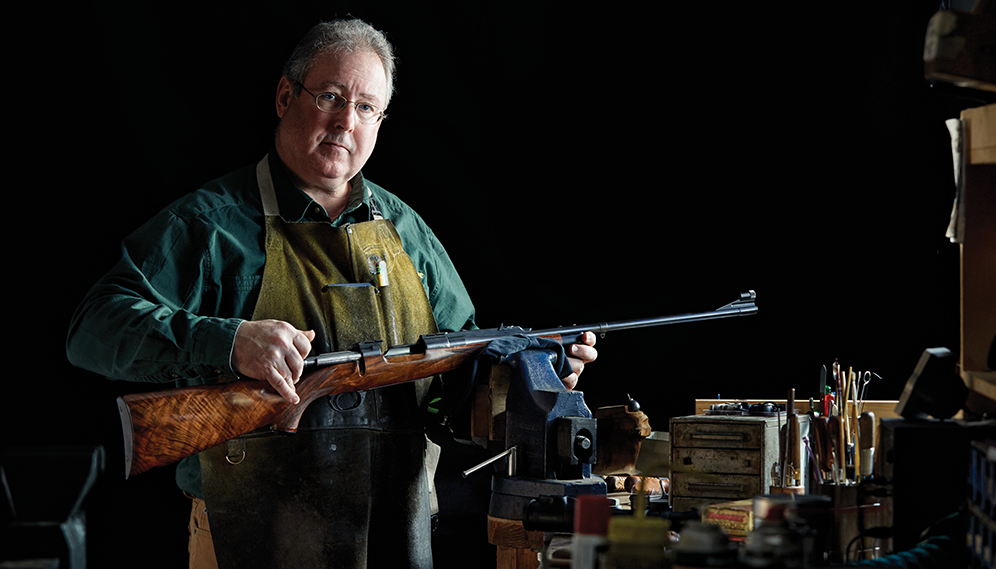
The Griffin & Howe store at 589 Broadway in Lower Manhattan has been a storied bastion of bespoke firearms for America’s ruling class starting in the 1920s. It was frequented by the Vanderbilts, the political dynasty of the Bush family, and Ernest Hemingway, who bought a rifle in .505 Gibbs. And it was where apprentice gunsmith Paul Chapman saw a trainee engraver on his first week of work nervously putting a lavish $30,000 Purdey shotgun in a vise, barely tightening the jaws, so afraid was he of damaging it. When he began working on it, the gun tumbled free and the stock broke right in front of one of the company’s vice presidents. “For every trainee gunsmith like myself who dreamed of working with high-grade guns,” says Chapman, “this was the biggest nightmare.”
It was 1979, and Chapman was a wide-eyed 19-year-old from Brooklyn with a passion for firearms by way of his uncle’s gun store in rural Vermont. At age 11, he applied naval jelly to his father’s rusty antique guns—stripping off the rust but also the bluing—in his burgeoning passion for gunsmith work.
The fourth-floor workshop at Griffin & Howe, where Chapman stood with eight others along a long bench, was where new artisans honed their skills. One of Chapman’s first jobs was to make up the bluing formulas in boiling vats. Sometimes they would overflow and drip down between the floorboards onto a furious architect’s drafting tables on the floor below.
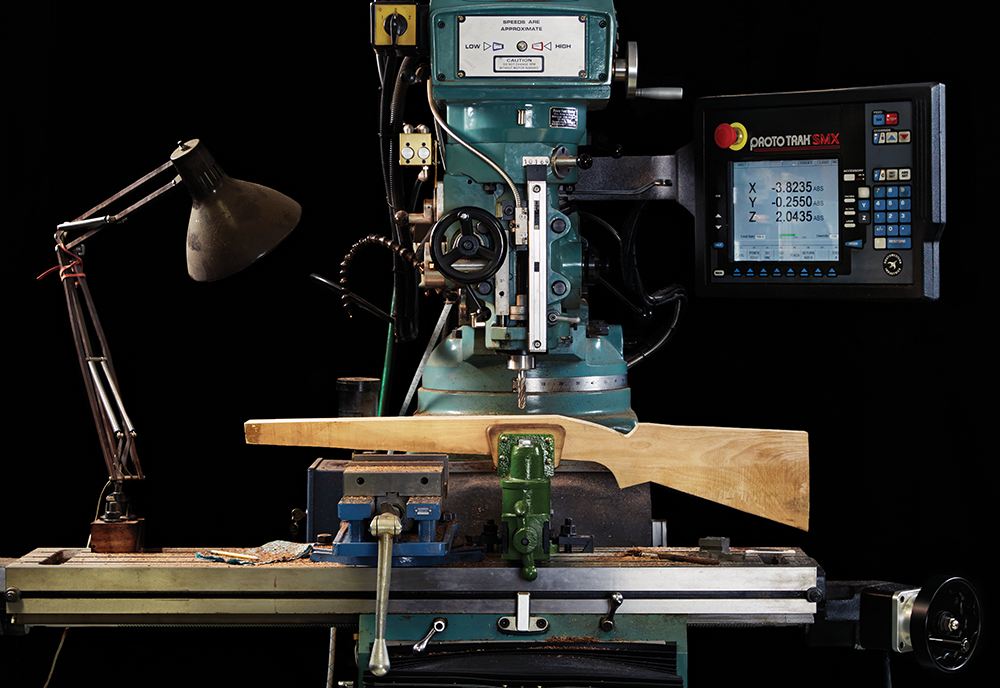
Chapman’s colleagues were an eclectic bunch. One diminutive Italian man who worked with gun barrels had learned his skill with metals by taking the dings out of torpedoes during World War II. Chapman’s mentor was Joe Sovenyhazi, a frail Hungarian who grew up in his family’s gun store and who suffered at the hands of the Germans during WWII. Sovenyhazi was captured twice, once by Americans and then by the Russians, escaping both times. Later, he got to the U.S. after defecting while a musician with a Hungarian orchestra. Sovenyhazi’s skills were so advanced he could make any piece of a gun, and do so with exquisite attention to detail.
Chapman was such a studious apprentice that he would take home the more mundane work of polishing barrels and making rings so that he could be given more important tasks to further hone his skills. Four years after starting at Griffin & Howe, he built his first gun, a .22 Hornet. He went on to adapt a Webley double-barreled shotgun into a double-barreled rifle, constructing the ribs from solid blocks of steel.
Today, 40 years later, Paul Chapman is head gunsmith at Griffin & Howe, leading a team of seven. He is, according to the company historian, the “personification of Griffin & Howe.” Recently he made a series of six guns for the Safari Club anniversary in calibers ranging from .22 Hornet to .416 Rigby, the set worth around $350,000. “Today in the high-end market, you’ll see a lot more engraving, a lot more bling,” says Chapman. “The old Purdeys and Holland & Hollands were understated and subtle guns. But since the mid 1950s, you’re seeing more ornate guns with bright finishes instead of case-color hardening.”
The store is still slammed with work—more so now that they are producing a high-tech line of long-distance rifles on Griffin & Howe chassis-style stocks. The rifles are designed with the close involvement of marksmanship instructor Eli Stulmacher, a former Navy SEAL sniper.
“There’s still a clientele for a hand-built gun,” says Chapman, “even though a lot of this generation doesn’t want well-made, hand-me-d
Source: https://www.outdoorlife.com/articles/hunting/2016/06/4-americas-greatest-gunsmiths/
