
Harmony Cronin calls her vagabond beginnings on the fringe of Yellowstone National Park “trucksteading.”
Raised by a non-hunting family in Denver, Cronin spent her early 20s bouncing around the West, sleeping in the beds of friends’ pickup trucks and seeking the sorts of people and knowledge that she wasn’t exposed to earlier in her life. Like early homesteaders in the area, she found she could make a living from the land—or, in her case, from the wild animals that occupy the land north of America’s oldest national park.
Cronin—a 27-year-old blonde, blue-eyed, and body-pierced evangelist for a modern back-to-the-land movement—can often be found in little Ennis, Mont., singing the praises of healthy, organic, free-range protein (read: wild game) and teaching others how to use an animal from its nose to its toes. She is especially interested in reviving traditional skin-tanning methods, including using the brains from an animal to soften and preserve its hide.
The Midnight Troubadour
Tough and timeless, this polo is built for the long ride. Featuring a crisp, non-collapsing collar and a rugged, stretchy fabric, it's the perfect shirt for any cowboy's wardrobe.
She got her start in tanning from a humble source. After killing and skinning a rat, she decided to try to develop skills that would allow her to use every piece of a harvested animal, even the pelt of a marauding rodent. That’s what led her to tanning.
Brain tanning is the ancient art of preserving animal hides using the emulsifying agents in brain matter, which helps break up the mucous membranes that cause animal hides to harden. This traditional method was used by many Native Americans for the preservation of buckskin with which to make clothing, but modern tanning methods in factories using chemical baths have largely replaced brain tanning. Only a handful of people still have the skill to tan hides using traditional methods; one of them is Harmony Cronin.
Cronin studied with master tanners and learned the art primarily through trial and error, she says. Her craft has kept her in Ennis. She initially offered to skin game in trade for hides that she could use to practice her craft, but after local butcher Chris Di’Michele of Deemo’s Meats saw how skilled Cronin was at skinning, he offered her a full-time job. That provided Cronin an opportunity to procure plenty of brains and plenty of skins, and it also afforded her time to perfect her skill. Now that she is an accomplished brain tanner (she also makes her own buckskin for clothing), Cronin offers classes to those interested in learning the craft. She’s even been asked by the tribes who participate in the annual Yellowstone Native American bison hunt outside Gardiner, Mont., to teach intensive brain-tanning courses at their respective reservations. Here’s her primer in brain-tanning hides.
Step 1 / Skinning and Fleshing
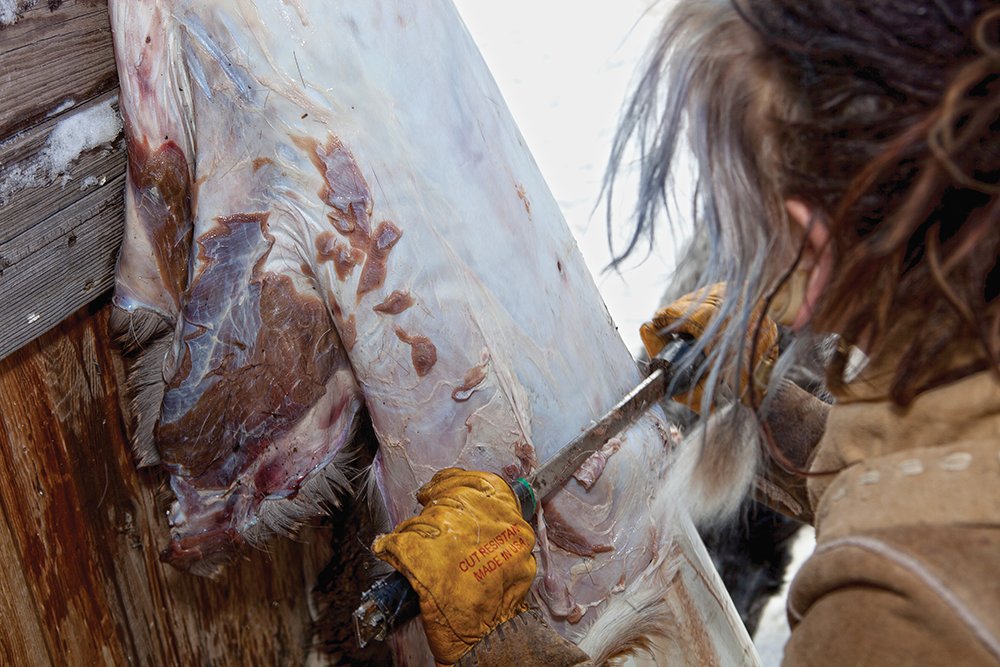
After the animal is skinned, the hide must be carefully fleshed to remove any leftover fat and tissue.
Step 2 / Initial Soaking

The hide must be soaked in water for up to three days. This allows the hair to slip, or loosen, and raises and softens the grain layer of the hide.
Step 3 / Graining
 https://www.outdoorlife.com/articles/hunting/2016/06/how-brain-tan-deer-hide-8-steps/