
For readers who follow environmental headlines, it may not be news that the list of the world’s 100 worst invasive species includes wild boar, feral goats, and rabbits. however, did you know that According to the Nature Conservancy, invasives (plants, fish, and animals) have contributed to the decline of 42 percent of all threatened and endangered species in the United States? Did you also know that the U.s. spends upwards of $120 billion a year attempting to control them? and were you aware that the list also includes trout, pike, and largemouth bass?
The Midnight Troubadour

Tough and timeless, this polo is built for the long ride. Featuring a crisp, non-collapsing collar and a rugged, stretchy fabric, it's the perfect shirt for any cowboy's wardrobe.
First, a clarification of terms. According to the United States Department of Agriculture (USDA), there is a distinct difference between invasive and non-native (alien) species.
It defines “invasive species” as, “plants, animals, or pathogens that are non-native (or alien) to the ecosystem under consideration and whose introduction causes or is likely to cause harm.”
Non-native species are species that have been introduced or expanded into new areas that have not historically been part of their native range, but aren’t necessarily harmful.
So let this story, then, serve as something of a cautionary tale regarding the wholesale condemnation of all non-native species. Because, truth be known, one conservationist’s invasive species might be another’s favorite hunting or fishing species. To prove the point, we decided to be contrarians for a moment and bring you this list of 10 nonindigenous species that, though they might do harm to the natural balance of their non-native ecosystem, also enrich our sporting lives.
1. RING-NECKED PHEASANT
Even though the ring-necked pheasant is not native to North America, it is the official state bird of South Dakota. The love affair American hunters have with pheasants began in 1881, with the first successful introduction of the game birds. An Oregon man named Owen Nickerson Denny, a former U.S. consul general in Shanghai, China, shipped 60 Chinese pheasants to Port Townsend, Washington. Few, if any, of those first birds survived; however, Denny released more birds in 1882 and 1884, and they soon began to flourish in Oregon’s Willamette Valley. From there the birds were transplanted to other regions, often by state game departments.
Today, the pheasants have been introduced across the continental U.S., as well as in Mexico and Hawaii, and there are self-sustaining populations in much of the Midwest and West. During the 2014 hunting season alone, South Dakota Game, Fish and Parks reports, 1,199,804 pheasants were shot by hunters (504,144 by residents, 695,660 by nonresidents). In South Dakota, pheasant hunting generates an estimated $223 million in retail economic impact annually, and an additional $111 million in salaries annually. Those revenues are the result of approximately 62,000 resident and 79,000 nonresident pheasant hunters purchasing licenses, fuel, food, and lodging during the state’s three-month hunting season. Plain and simple, pheasants are big business in South Dakota. That’s why Pheasants Forever recently established a regional headquarters in Brookings, South Dakota, with the goal of sustaining a 1.5 million rooster harvest.
Jared Wiklund, public-relations specialist for Pheasants Forever, says, “With an estimated 2 million pheasant hunters in North America, the ring-necked pheasant has progressed from an introduced, non-native species to an iconic resident of the Great Plains.”
The ring-necked pheasant is not included on the USDA list, but rather is commonly referred to as a beneficial “non-native species” by state agencies and biologists throughout the country. Also, as part of the federal Farm Bill, the USDA has incentivized conservation practices that are designed to increase populations of this upland game bird. “And in fact,” Wiklund says, “the projects Pheasants Forever implements also benefit deer, waterfowl, turkeys, songbirds, endangered species, and water quality.”
2. TROUT
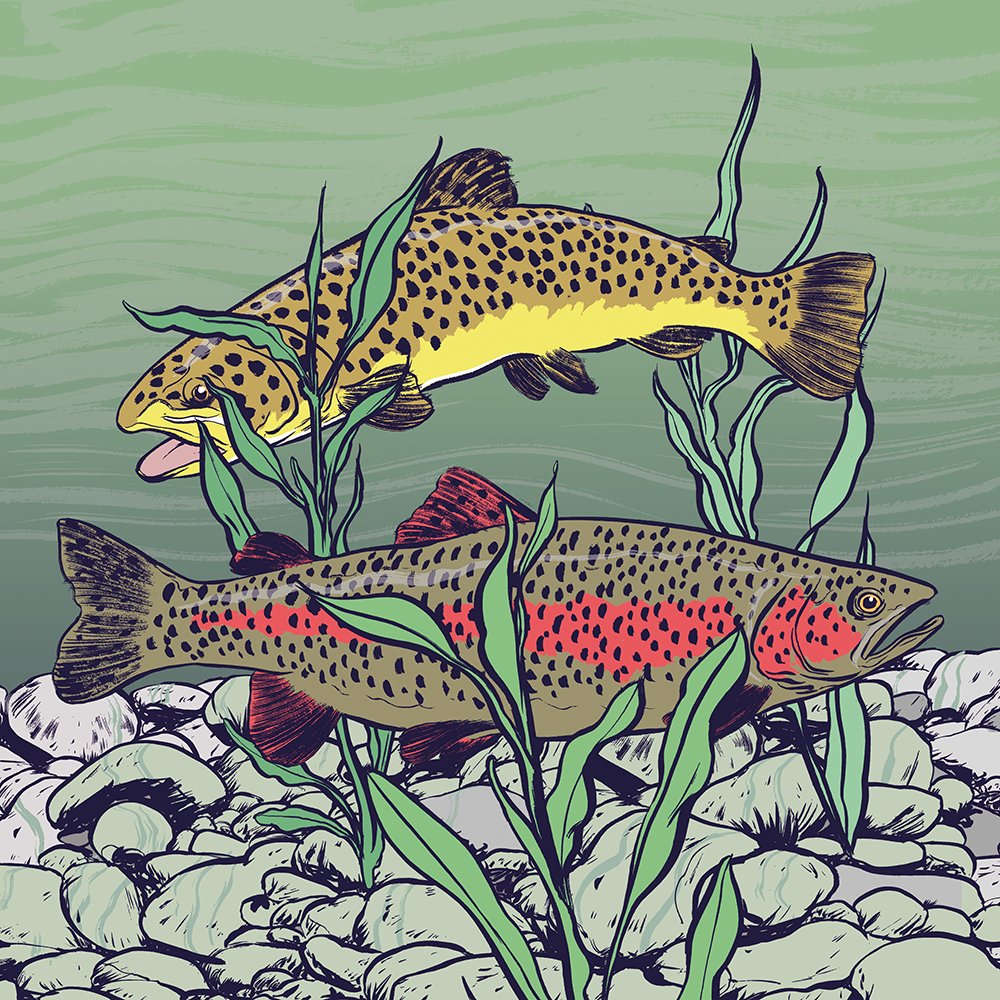
Considering what deforestation and pollution did to native trout populations in North America in the 18th and 19th centuries, it isn’t surprising that some fishermen decided to transplant European brown trout to our lakes and streams. What is surprising is that it took them so long. Many historians say that the first successful introduction of browns to the U.S. took place in April 1884, when the U.S. Fish Commission released 4,900 brown trout fry into the Baldwin River, a tributary of the Pere Marquette River in Michigan. Soon thereafter, brown trout were planted across the U.S.
These fish expanded their habitat and devoured some of the native brook trout that were then still in the East. They did the same to cutthroat populations in the West. Meanwhile, rainbow trout from the West Coast were spawned in hatcheries and moved east. Many people say that the rainbow is a native of the Northwest, but some taxonomists point out that rainbows have been interbred so much in hatcheries that what we have now are not native to any place, but are a human-made concoction. If you think gun writers can be pedantic, try getting a few taxonomists together.
Though brown and rainbow trout now reign supreme from New York’s Beaverkill to Michigan’s Pere Marquette to Montana’s Madison River, native trout are seeing a resurgence as fisheries managers restock various subspecies of cutthroat and brook trout to their native ranges. Some streams in the West have even been poisoned to kill non-native brook and rainbow trout so native cutthroats can be restocked. Overall, there is no doubt fishermen have benefitted immeasurably from these introductions. Trout fishing attracted 7.2 million anglers, resulting in 76 million angler days in 2011, according to the U.S. Fish and Wildlife Service’s National Survey of Fishing, Hunting, and Wildlife-Associated Re
